 1 / 11
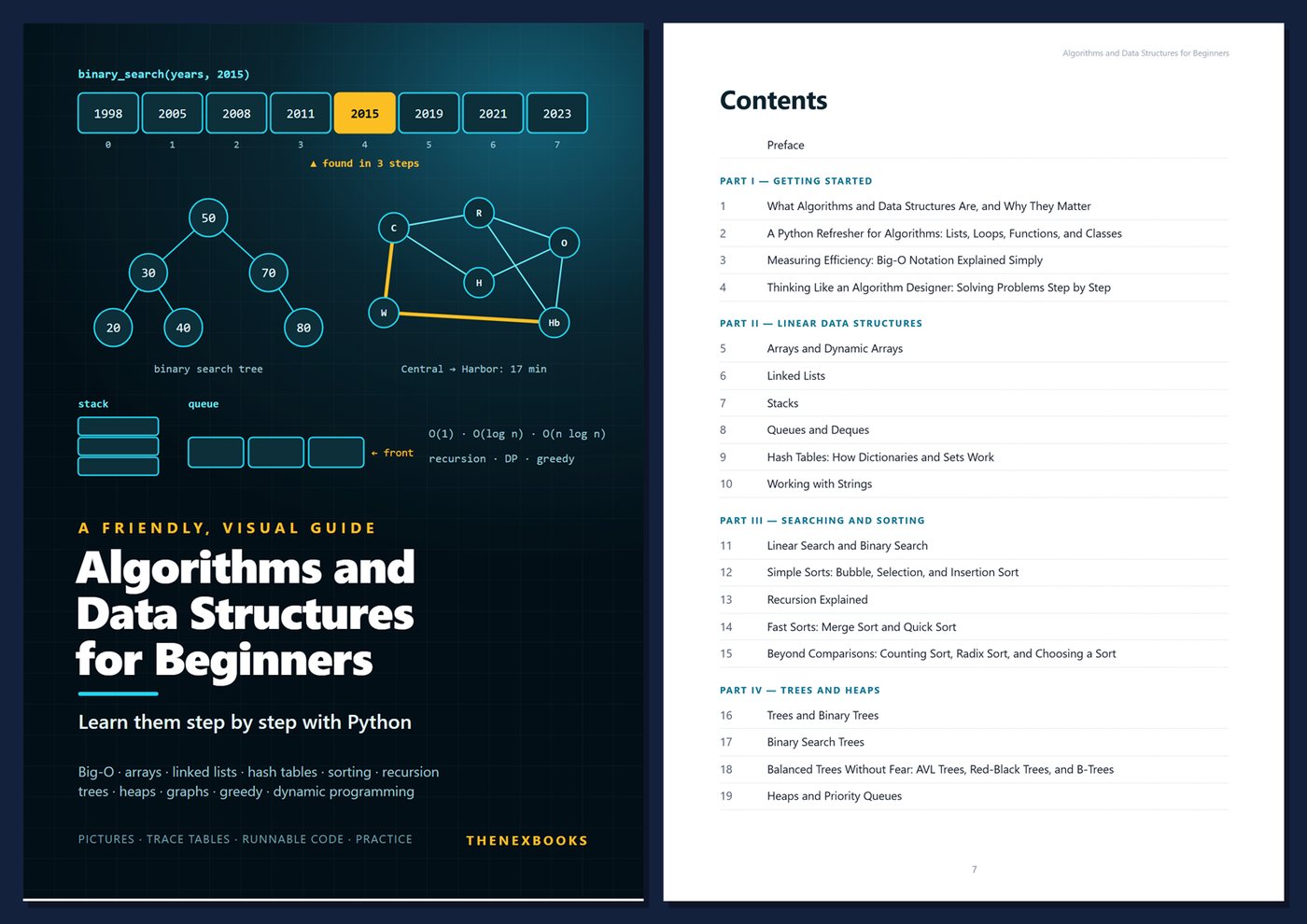
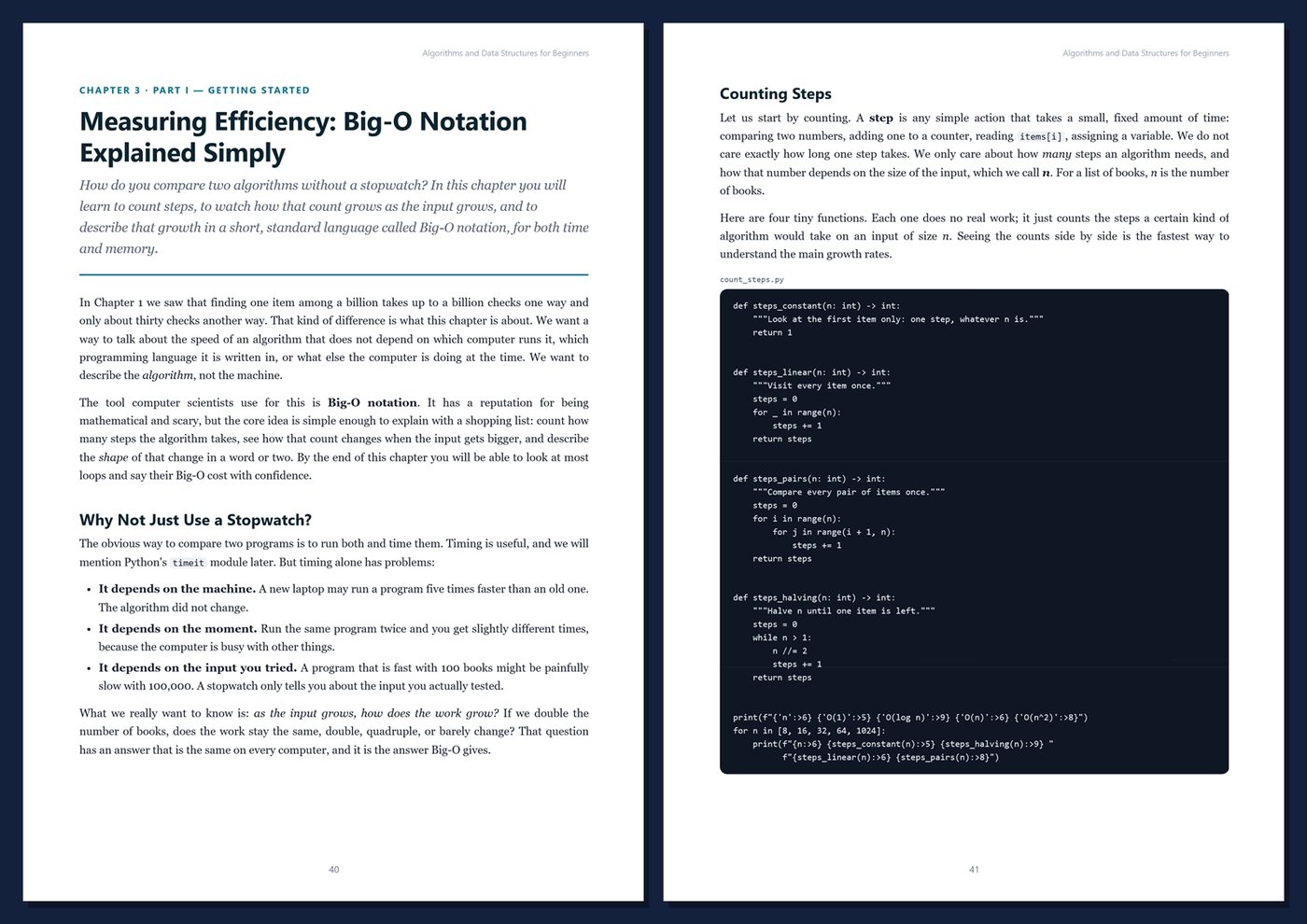
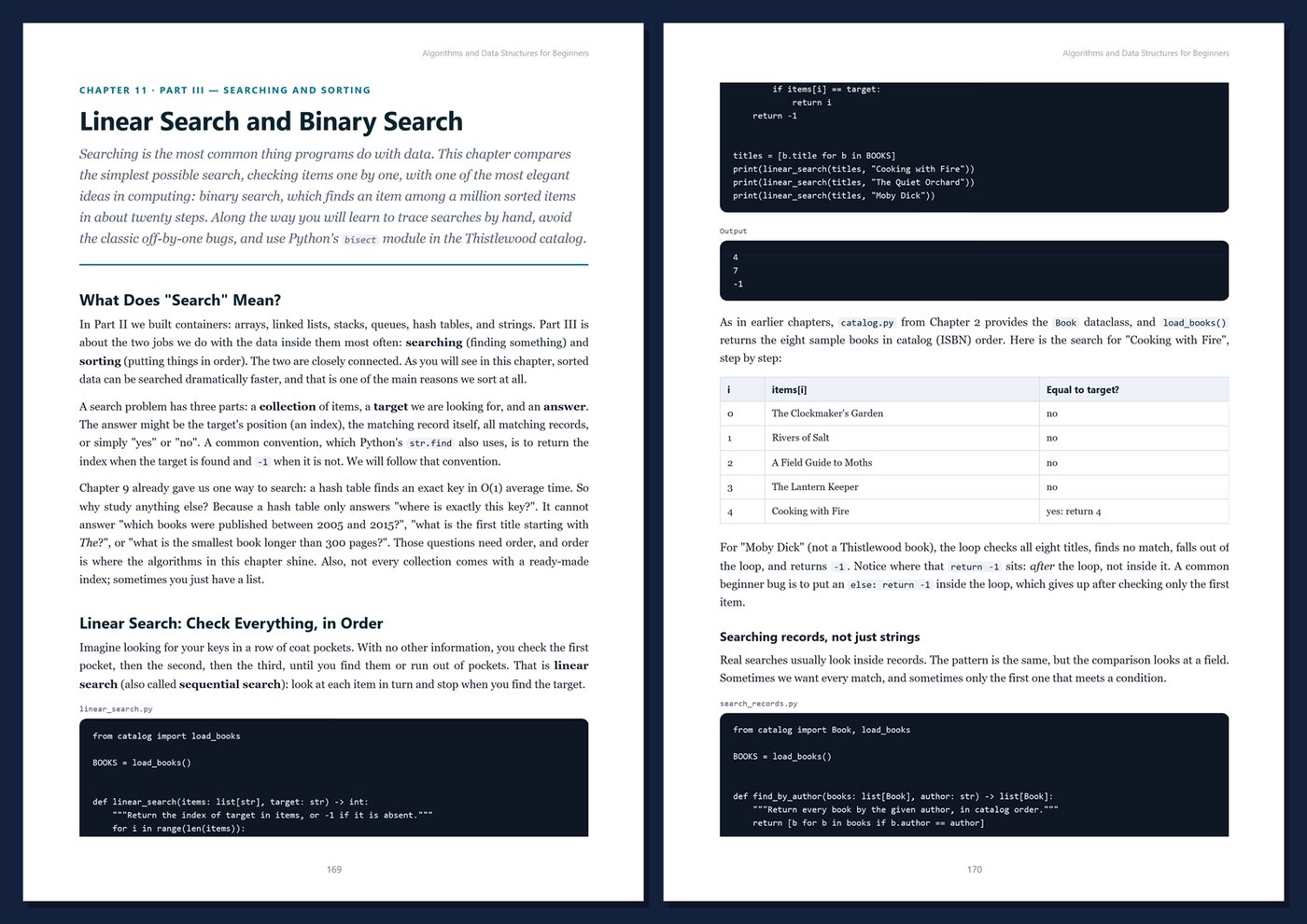
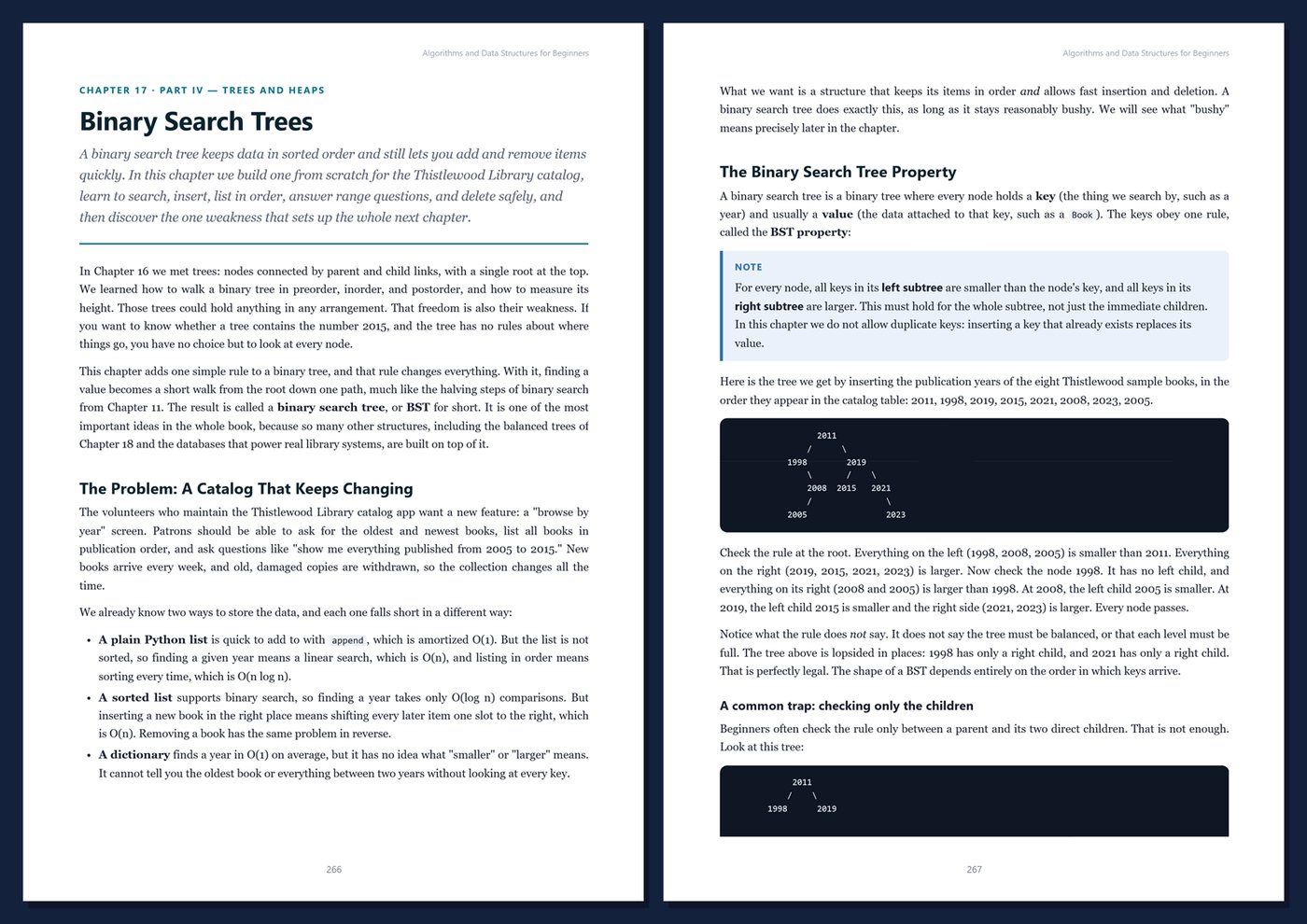
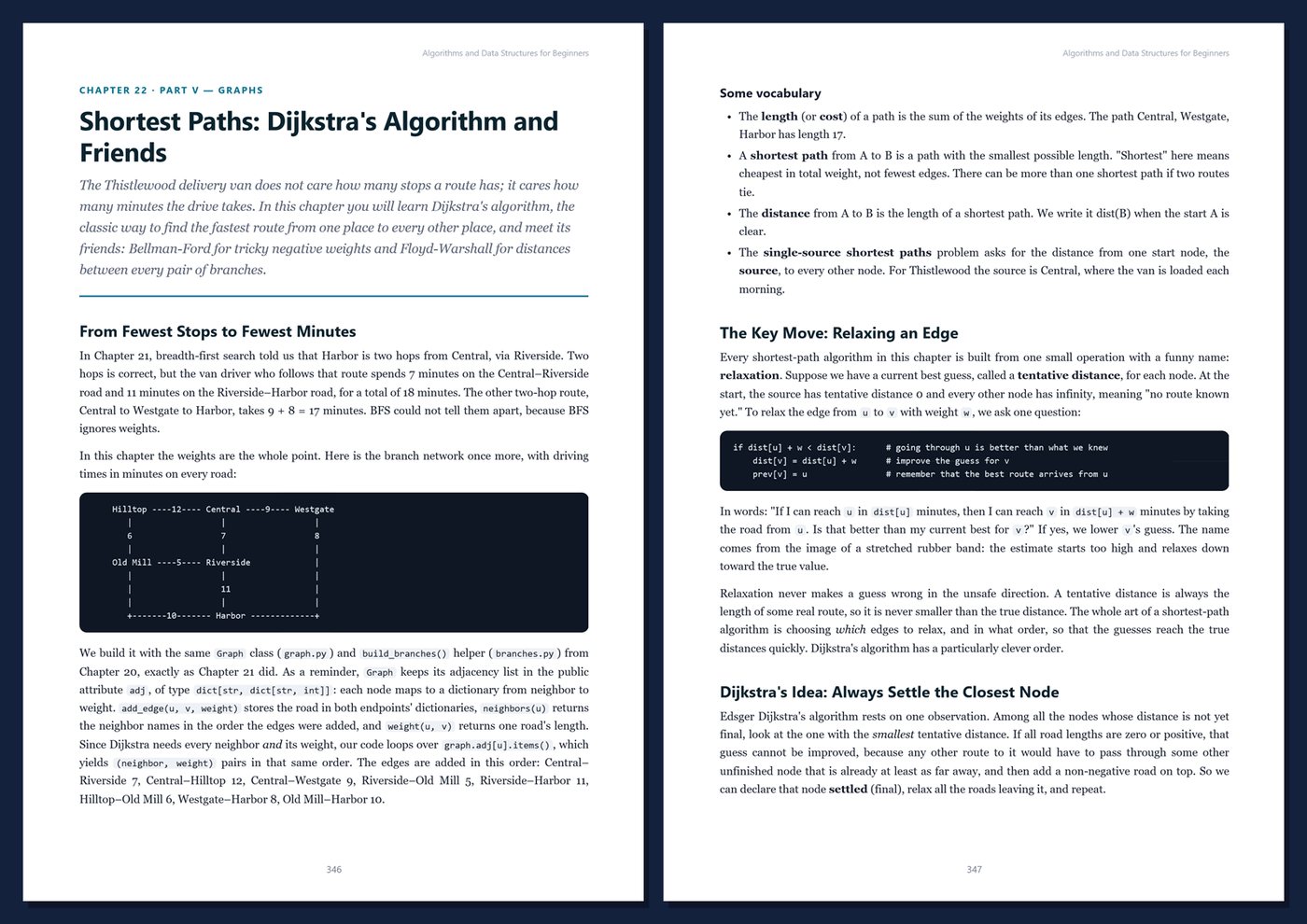
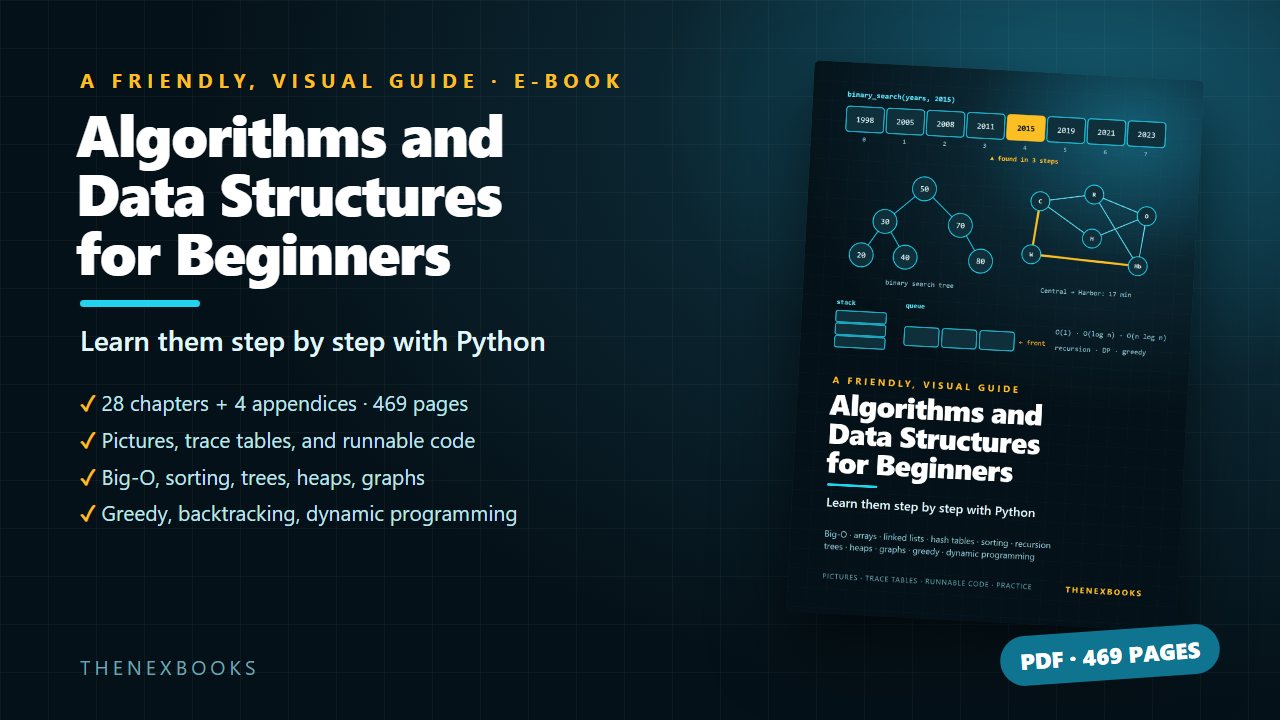
A 469-page friendly, visual introduction to algorithms and data structures with Python — pictures, step-by-step trace tables, runnable code, and practice exercises, from Big-O to graphs and dynamic programming.
A Friendly, Visual Guide with Python
Read before you buy: the PDF here is a free sample — the first 20 pages of the 469-page book (payments, sales and reviews on this demo site are sample data). Get the full e-book at thenexbooks on Gumroad.
Algorithms and data structures don't have to be a wall of math.
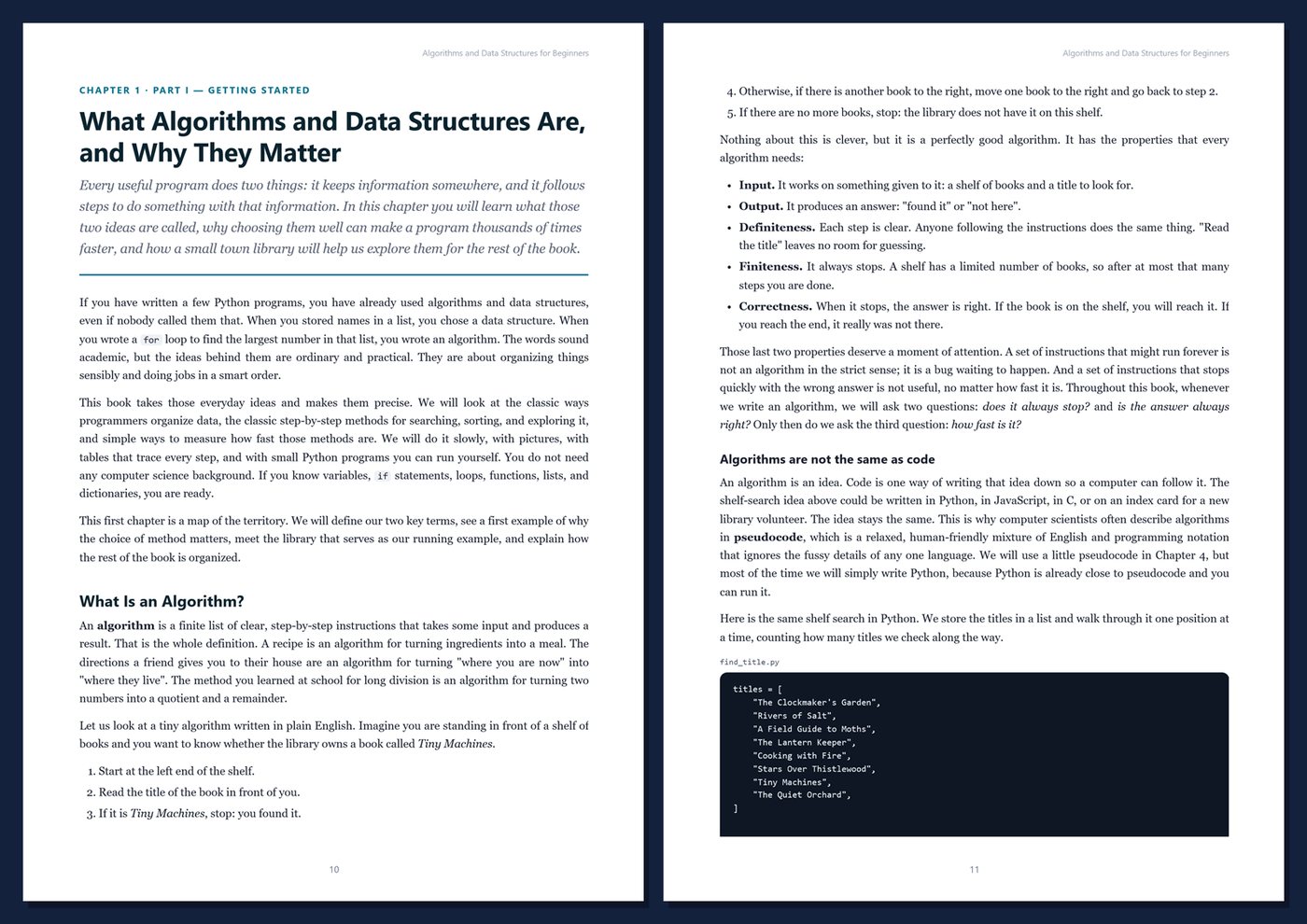
Every program you use is built from data and steps. How the data is organized and how the steps are arranged decide whether an app answers instantly or makes you wait. These ideas have a reputation for being hard — but almost every one of them can be explained with something you already know: a stack of plates, a line at a counter, a phone's contact list, a paper map.
That is how this book teaches. For each idea we start with a picture and an everyday example, walk through it step by step with a trace table, write it in plain Python, and only then ask how fast it is and why. Along the way you help the volunteers of Thistlewood Library build their catalog app — searching and sorting books, a fair queue for holds, undo, autocomplete, the fastest route for the delivery van, and a reading-challenge planner — so you always know why each idea matters.
- 469 pages · 28 chapters + 4 appendices
- Written for beginners who know basic Python — no computer-science background or advanced math needed
- Big-O notation explained simply, plus a step-by-step method for solving problems
- Arrays, linked lists, stacks, queues, deques, hash tables, and strings
- Linear and binary search; bubble, selection, insertion, merge, quick, counting, and radix sort
- Recursion explained with pictures and call stacks
- Trees, binary search trees, balanced trees, heaps, and priority queues
- Graphs, BFS and DFS, Dijkstra's shortest paths, minimum spanning trees, topological sort, and union-find
- Greedy algorithms, divide and conquer, backtracking, and dynamic programming for beginners
- Handy patterns: tries, two pointers, sliding windows, and prefix sums
- Practice exercises in every chapter, a Big-O cheat sheet, a Python reference, and a twelve-week study plan
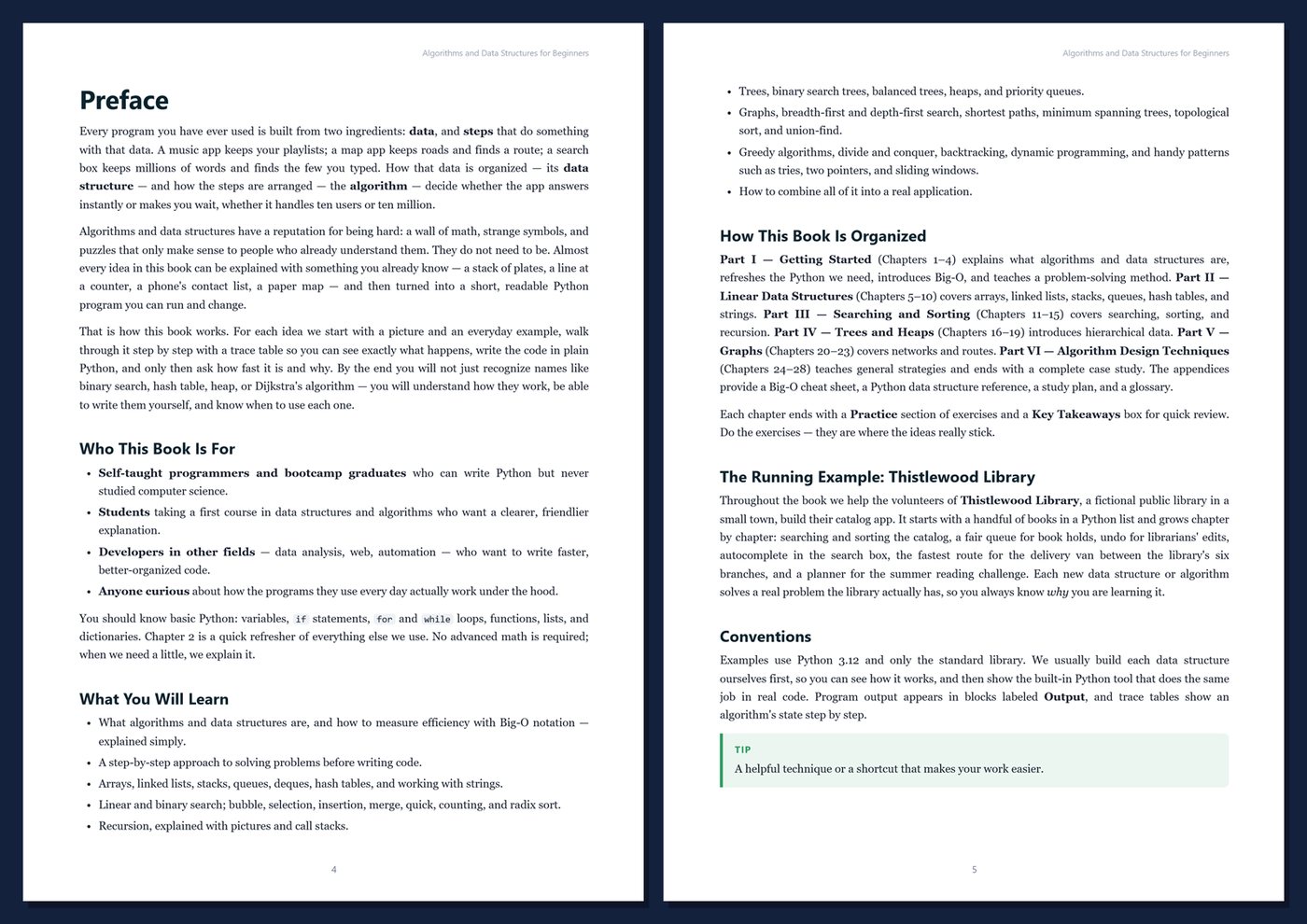
Table Of Contents
Part I — Getting Started
- Ch 1 · What Algorithms and Data Structures Are, and Why They Matter
- Ch 2 · A Python Refresher for Algorithms: Lists, Loops, Functions, and Classes
- Ch 3 · Measuring Efficiency: Big-O Notation Explained Simply
- Ch 4 · Thinking Like an Algorithm Designer: Solving Problems Step by Step
Part II — Linear Data Structures
- Ch 5 · Arrays and Dynamic Arrays
- Ch 6 · Linked Lists
- Ch 7 · Stacks
- Ch 8 · Queues and Deques
- Ch 9 · Hash Tables: How Dictionaries and Sets Work
- Ch 10 · Working with Strings
Part III — Searching and Sorting
- Ch 11 · Linear Search and Binary Search
- Ch 12 · Simple Sorts: Bubble, Selection, and Insertion Sort
- Ch 13 · Recursion Explained
- Ch 14 · Fast Sorts: Merge Sort and Quick Sort
- Ch 15 · Beyond Comparisons: Counting Sort, Radix Sort, and Choosing a Sort
Part IV — Trees and Heaps
- Ch 16 · Trees and Binary Trees
- Ch 17 · Binary Search Trees
- Ch 18 · Balanced Trees Without Fear: AVL Trees, Red-Black Trees, and B-Trees
- Ch 19 · Heaps and Priority Queues
Part V — Graphs
- Ch 20 · Graphs: Vocabulary and Representations
- Ch 21 · Graph Traversal: Breadth-First and Depth-First Search
- Ch 22 · Shortest Paths: Dijkstra's Algorithm and Friends
- Ch 23 · Minimum Spanning Trees, Topological Sort, and Union-Find
Part VI — Algorithm Design Techniques
- Ch 24 · Greedy Algorithms
- Ch 25 · Divide and Conquer and Backtracking
- Ch 26 · Dynamic Programming for Beginners
- Ch 27 · Handy Patterns: Tries, Two Pointers, Sliding Windows, and Prefix Sums
- Ch 28 · Case Study: Building the Thistlewood Library Catalog
Appendices
- App A · Big-O Cheat Sheet
- App B · Python Data Structure Reference
- App C · Study Plan and Practice Checklist
- App D · Glossary
WHO IT IS FOR
Self-taught programmers and bootcamp graduates who never studied computer science, students taking a first data structures and algorithms course, developers in data, web, or automation who want to write faster code, and anyone curious about how programs work under the hood. You should know basic Python: variables, if statements, loops, functions, lists, and dictionaries.
FORMAT
PDF (A4), 469 pages, English, clickable table of contents and PDF bookmarks. 1st Edition, 2026. Published by thenexbooks.
This book is independent and is not affiliated with or endorsed by the Python Software Foundation. Python is a trademark of the Python Software Foundation.
Book details
| Detail | |
|---|---|
| Pages | 469 |
| Format | PDF (A4) |
| Language | English |
| Level | Beginner |
| Edition | 1st Edition, 2026 |
| Download on this site | Free sample, first 20 pages (PDF) |
| Publisher | thenexbooks |
Files you get
No reviews yet. Only buyers can review.
More from thenexbooks