 1 / 11
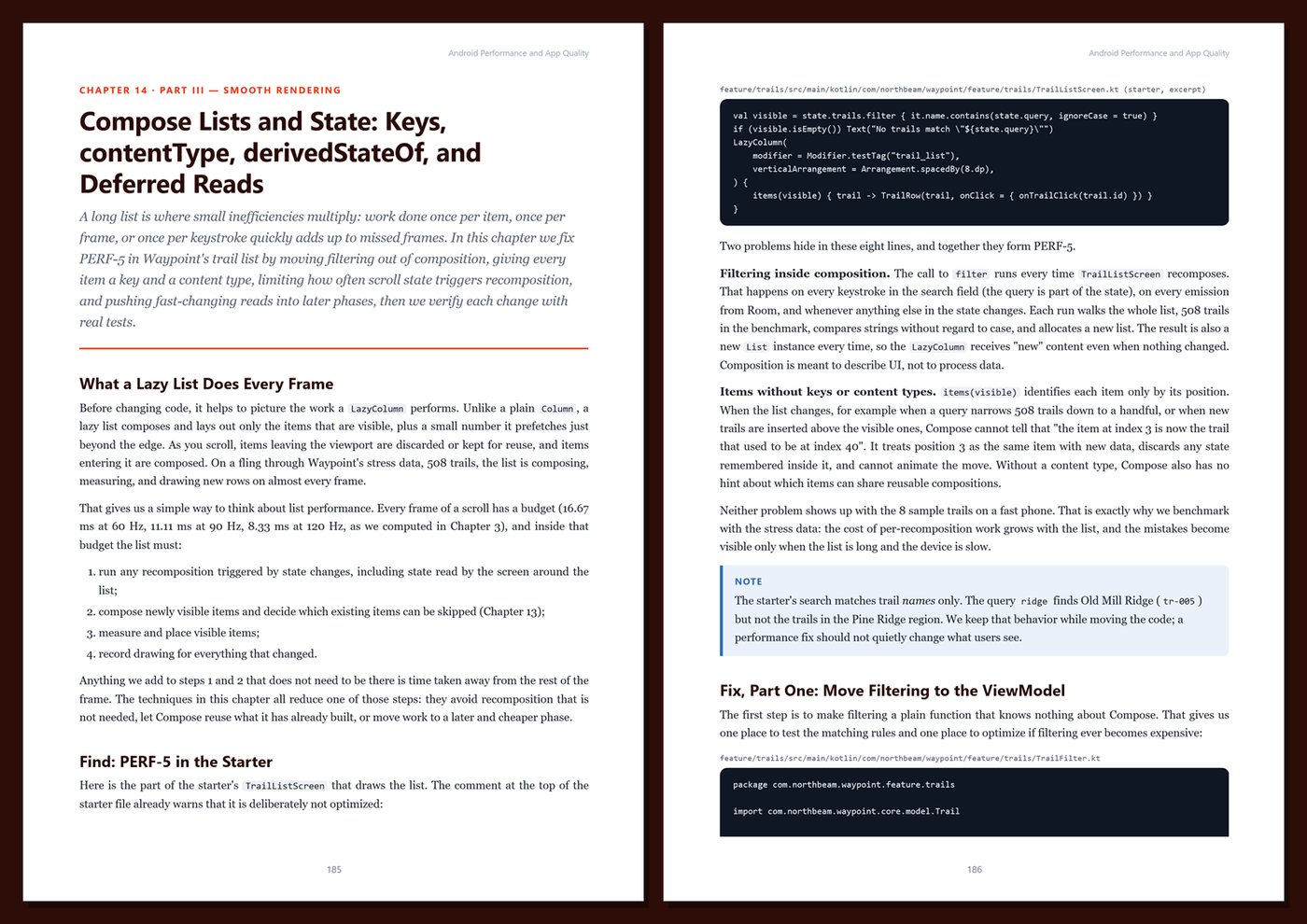
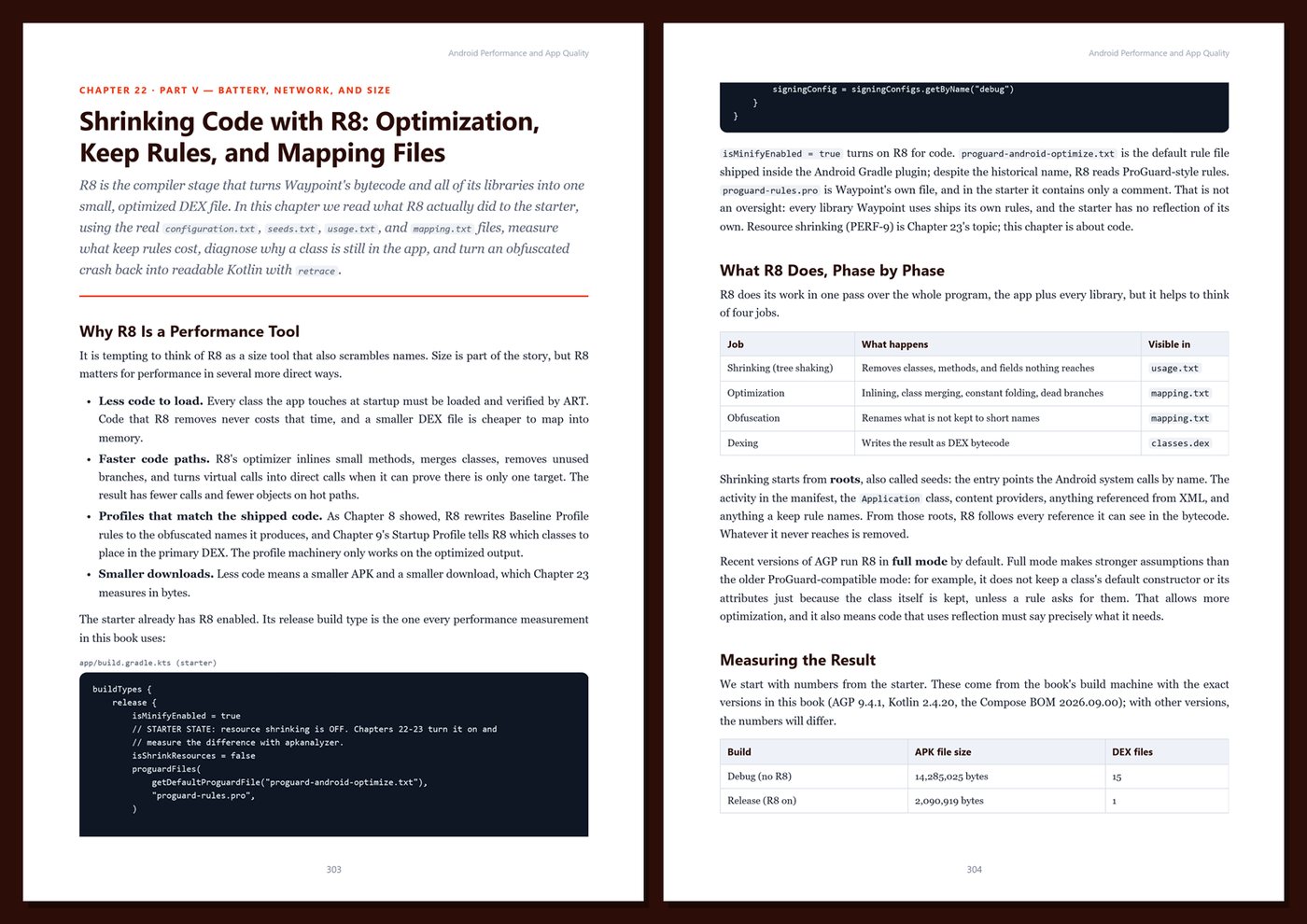
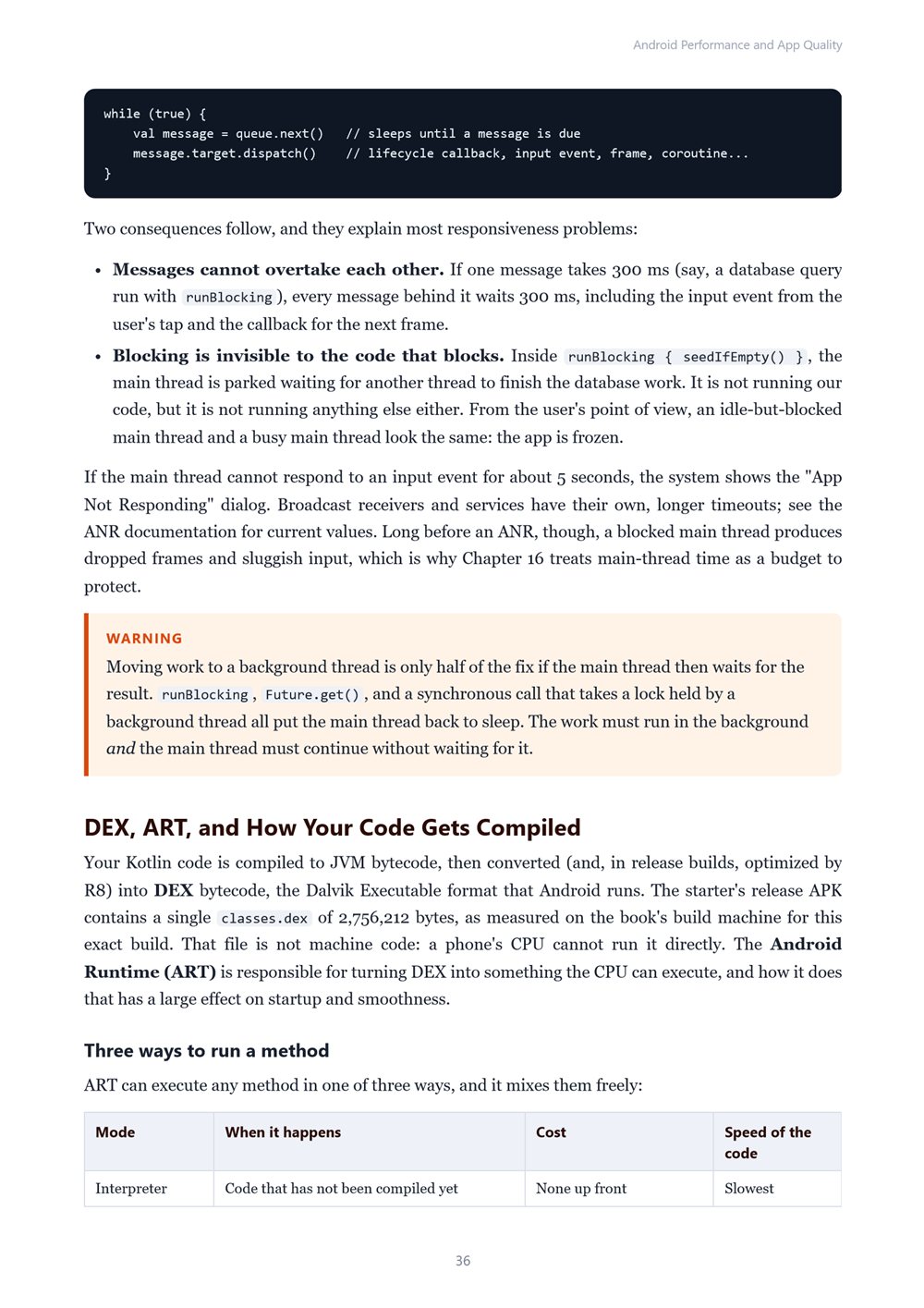
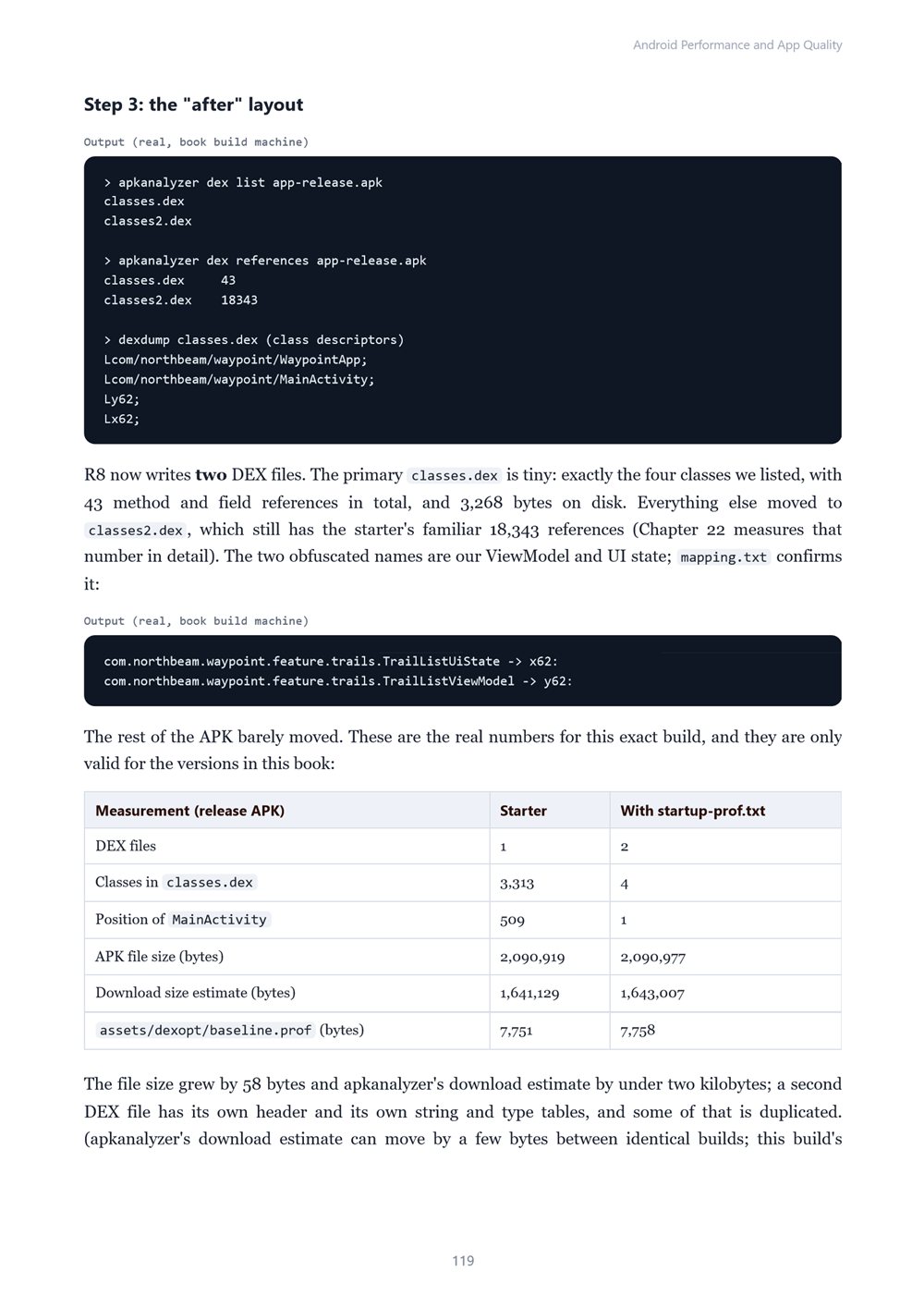
Make Android apps start fast, scroll smoothly, and stay lean: the performance mindset and Android vitals, how ART and the frame pipeline work, Perfetto and the Android Studio profilers, Macrobenchmark and Microbenchmark, cold/warm/hot startup and TTID/TTFD, lazy initialization and the App Startup…
Startup, Rendering, Memory, Battery, App Size, and Baseline Profiles — Measuring What Users Feel
Read before you buy: the PDF here is a free sample — the first 20 pages of the 420-page book (payments, sales and reviews on this demo site are sample data). Get the full e-book at thenexbooks on Gumroad.
Stop guessing why your app feels slow. Measure what users feel, fix what matters, and keep it fast release after release.
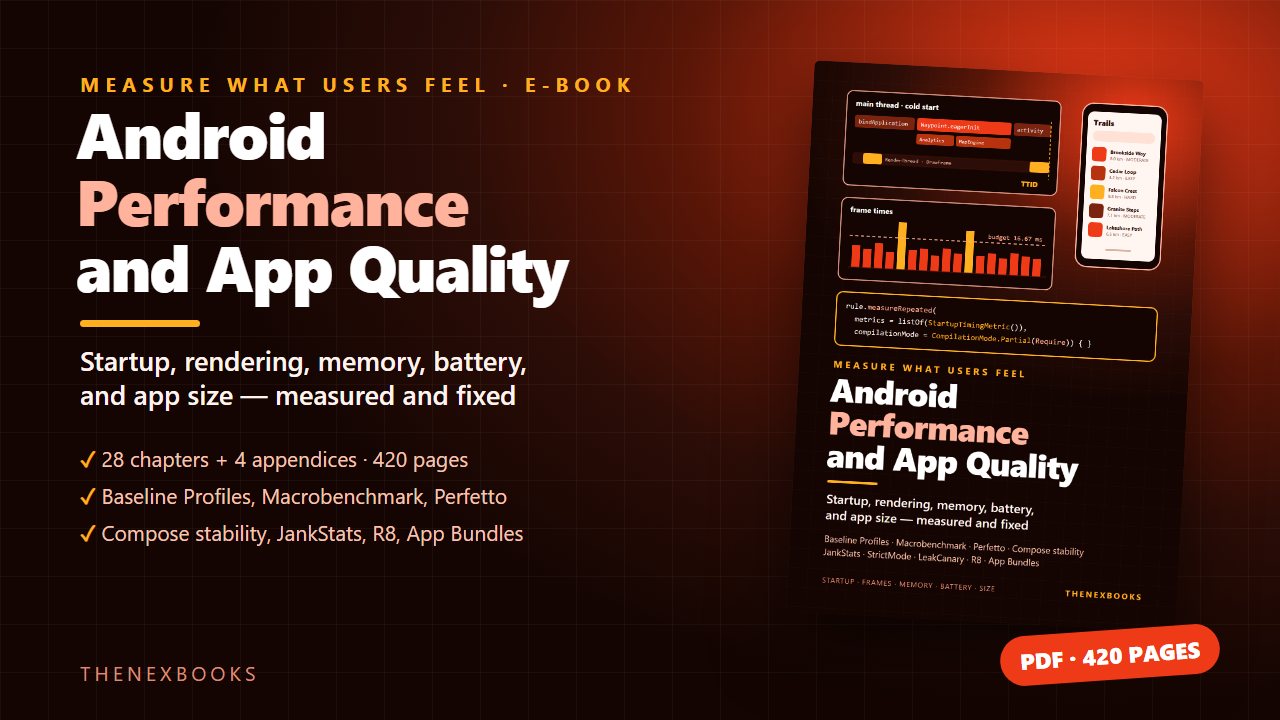
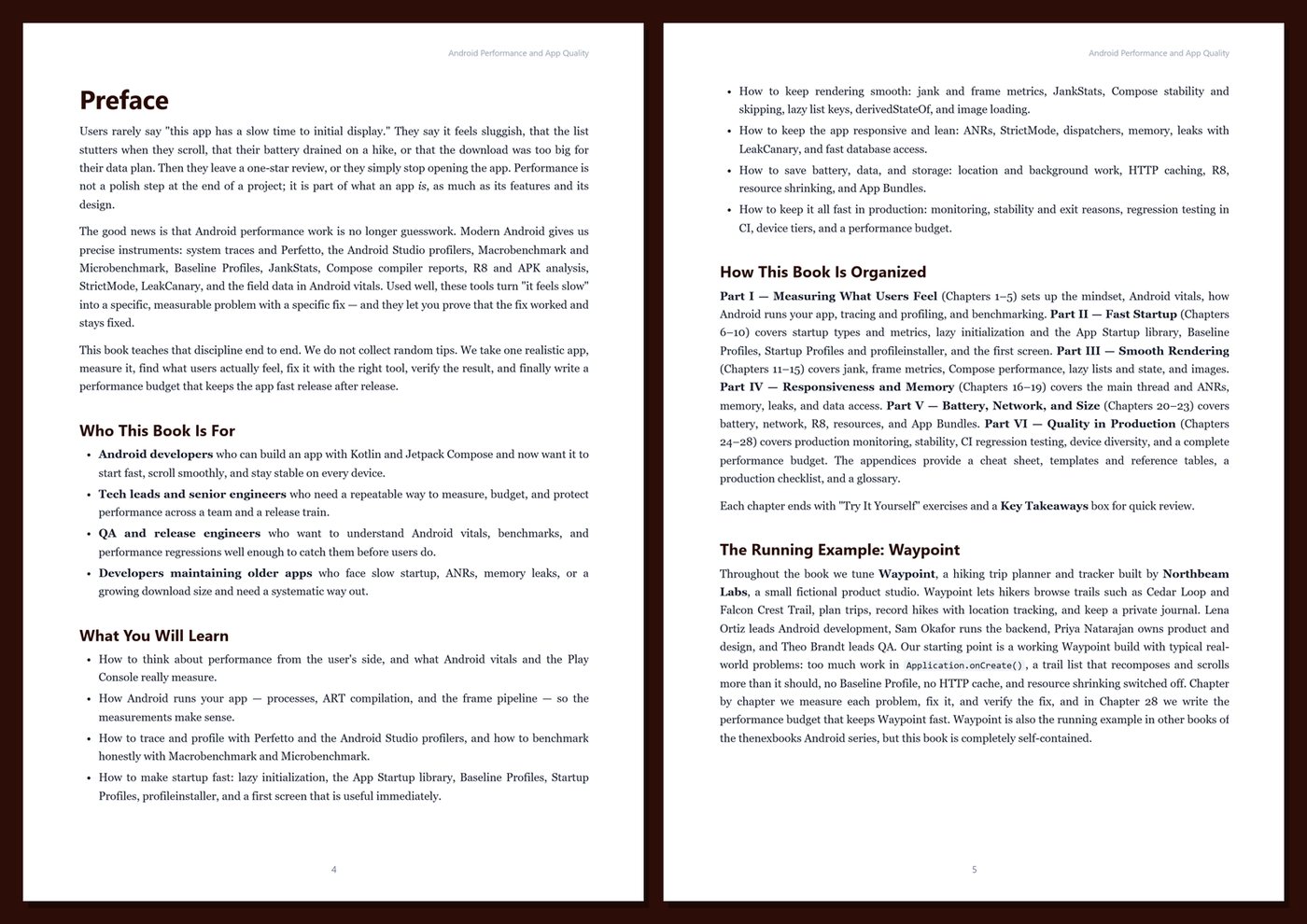
Users never say "the time to initial display regressed." They say the app takes forever to open, the list stutters, the battery drained on a hike, or the download was too big. Modern Android gives you precise instruments to turn those complaints into specific, fixable problems: system traces and Perfetto, the Android Studio profilers, Macrobenchmark and Microbenchmark, Baseline Profiles, JankStats, Compose compiler reports, StrictMode, LeakCanary, R8 and APK analysis, and the field data in Android vitals.
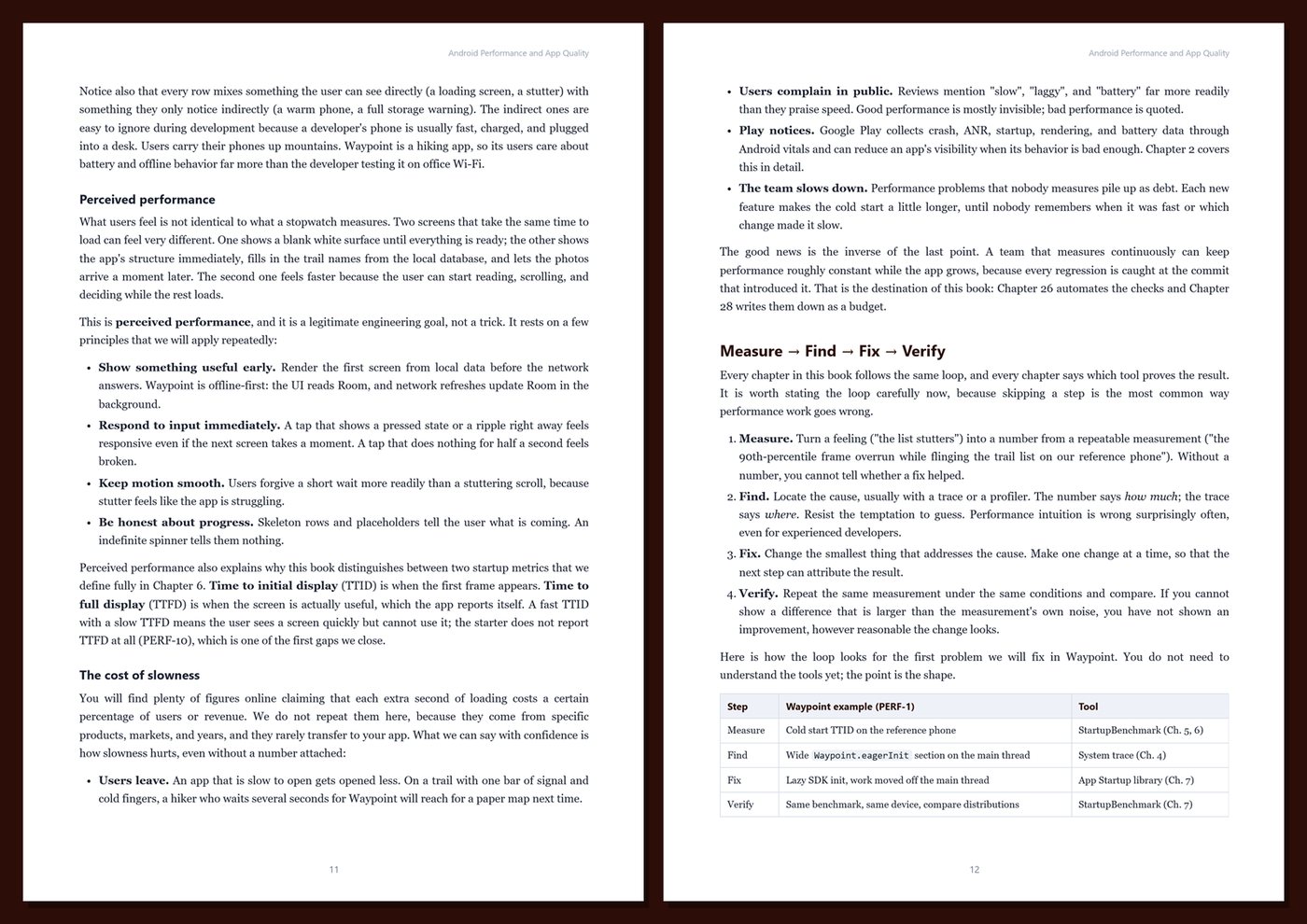
This book teaches the whole discipline with one loop — measure, find, fix, verify — applied chapter by chapter to one realistic Kotlin and Jetpack Compose app, until it ends with a performance budget your whole team can enforce.
What's inside
- The performance mindset: what users feel, lab vs field data, and what Android vitals and the Play Console actually report (and how to read them without myths)
- How Android runs your app: processes, ART interpretation, JIT and AOT compilation, profile-guided compilation, and the frame pipeline
- Tracing and profiling with Perfetto, system traces, custom trace sections, and the Android Studio profilers
- Benchmarking done right: Macrobenchmark for startup and scrolling, Microbenchmark for hot code, compilation modes, and honest statistics
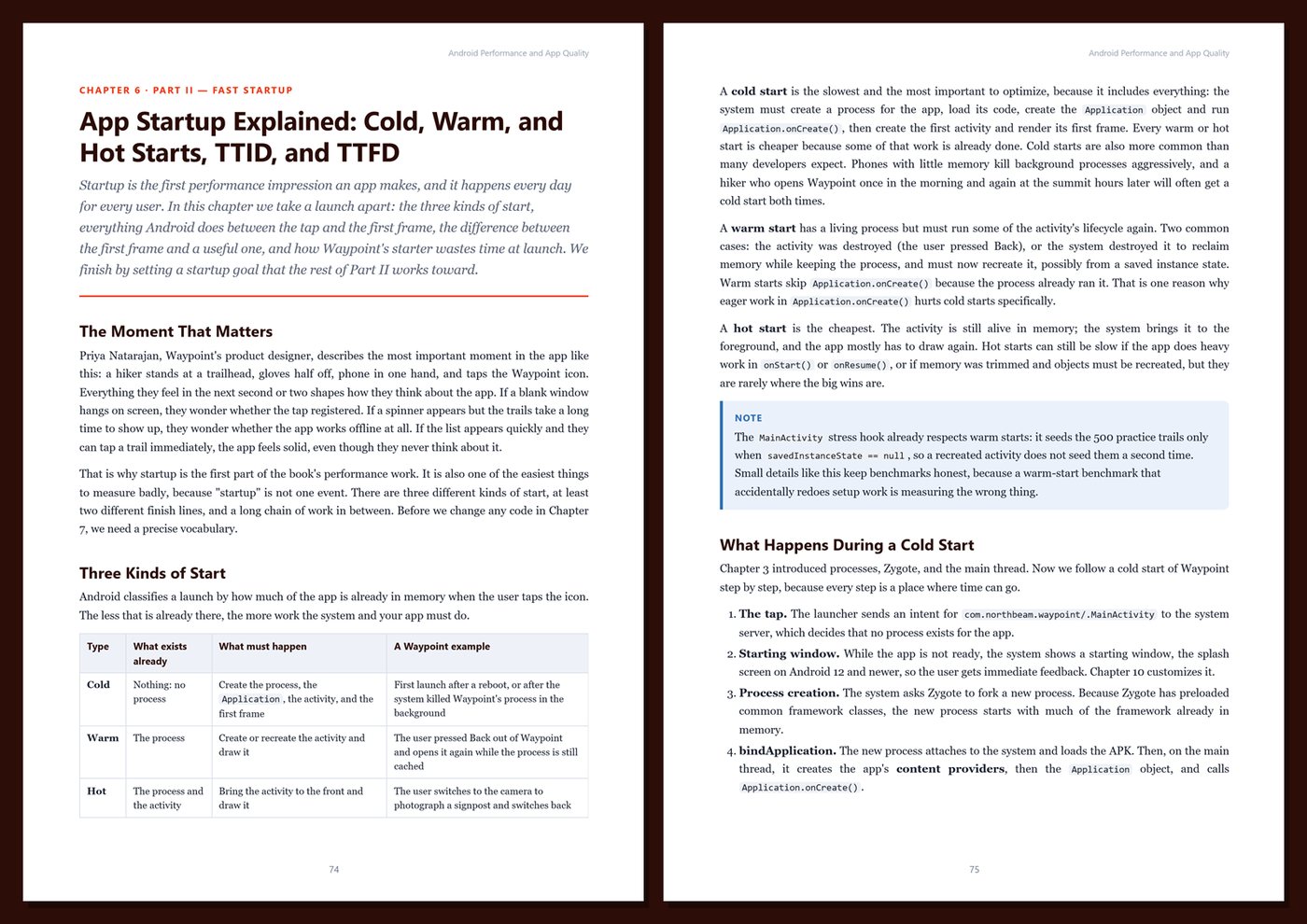
- Fast startup: cold, warm, and hot starts, TTID and TTFD, lazy initialization, the App Startup library, splash screens, and reportFullyDrawn
- Baseline Profiles and Startup Profiles: generating, shipping, verifying, DEX layout, and profileinstaller
- Smooth rendering: jank and frame deadlines, JankStats, FrameTimingMetric, Compose recomposition, stability, strong skipping, lazy list keys and contentType, derivedStateOf, deferred reads, and image loading with Coil
- Responsiveness and memory: ANRs, StrictMode, coroutine dispatchers, the heap and garbage collection, onTrimMemory, and finding leaks with LeakCanary and heap dumps
- Fast data: Room query plans, indexes, migrations, paging, and transactions
- Battery and network: efficient location tracking, batched uploads with WorkManager, HTTP caching, compression, and prefetching
- App size: R8 shrinking and optimization, keep rules, mapping files, resource shrinking, native libraries, App Bundles, and apkanalyzer
- Quality in production: monitoring, crashes, ANRs and process exit reasons, regression testing in CI, device tiers, and a complete performance budget
One running example, start to finish. You tune Waypoint, a hiking trip planner and tracker from the fictional studio Northbeam Labs, built with Kotlin, Jetpack Compose, Hilt, Room, Retrofit, and Coil. The starter project comes with real-world performance debt — too much work in Application.onCreate, unstable Compose parameters, a list without keys, no Baseline Profile, no HTTP cache, resource shrinking switched off — and each chapter measures one problem, fixes it, and proves the fix with the right tool. Waypoint is shared with the other books of the thenexbooks Android series, but this book is completely self-contained.
Current and honest. Examples use Kotlin 2.4, the Android Gradle Plugin 9.4, Compose BOM 2026.09.00, compileSdk 37, and the Jetpack benchmark libraries 1.5 — the stable releases at the time of writing. The book contains no invented benchmarks or statistics: device-dependent results are shown as the shape of the output you should expect, while numbers from deterministic tools such as APK size analysis and Compose compiler reports were produced by running them on the book's sample project. Every chapter includes code, Tips, Notes, Warnings, exercises, and Key Takeaways, and the appendices give you a cheat sheet, templates and reference tables, a production checklist, and a glossary.
Format: PDF, 420 pages (A4), linked table of contents and bookmarks. English. First Edition, 2026. Published by thenexbooks. Includes the Waypoint starter project (Gradle, Kotlin) used throughout the book. Requires JDK 21 and the Android SDK (Android Studio recommended) to build the code. For readers who already build Android apps with Kotlin and Jetpack Compose. This book is independent and is not affiliated with, sponsored by, or endorsed by Google LLC.
Table of Contents
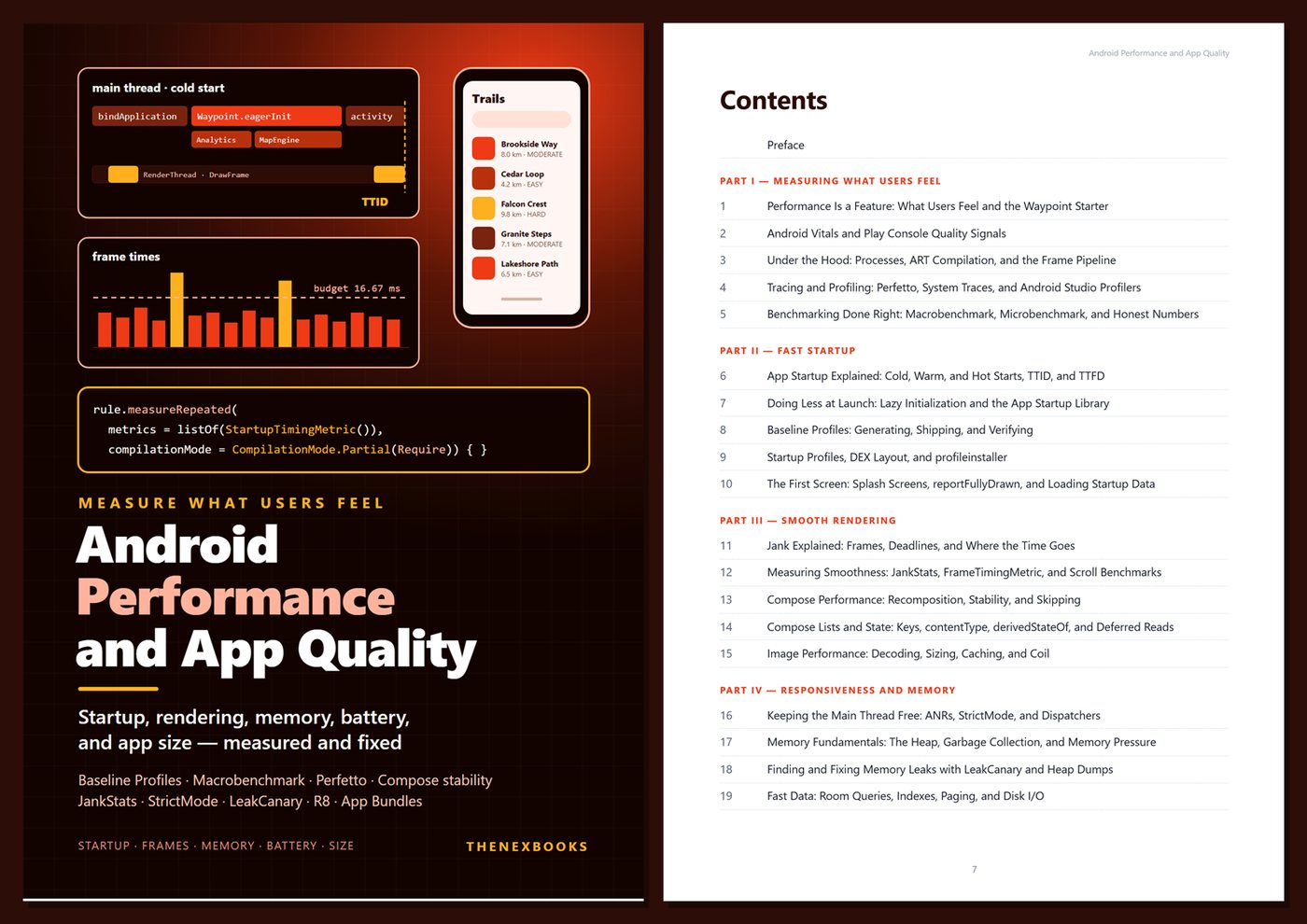
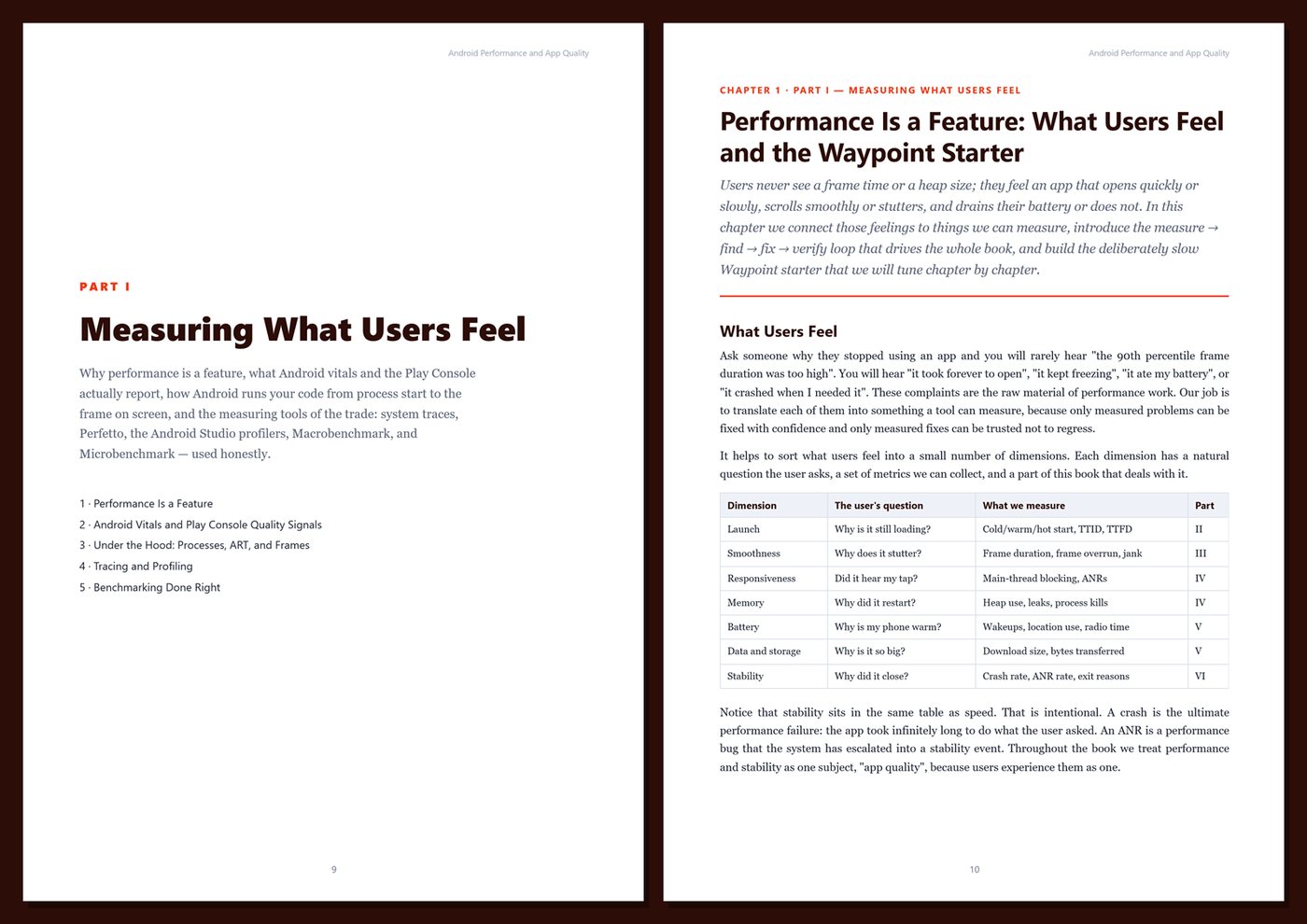
Part I — Measuring What Users Feel
- Ch 1 · Performance Is a Feature: What Users Feel and the Waypoint Starter
- Ch 2 · Android Vitals and Play Console Quality Signals
- Ch 3 · Under the Hood: Processes, ART Compilation, and the Frame Pipeline
- Ch 4 · Tracing and Profiling: Perfetto, System Traces, and Android Studio Profilers
- Ch 5 · Benchmarking Done Right: Macrobenchmark, Microbenchmark, and Honest Numbers
Part II — Fast Startup
- Ch 6 · App Startup Explained: Cold, Warm, and Hot Starts, TTID, and TTFD
- Ch 7 · Doing Less at Launch: Lazy Initialization and the App Startup Library
- Ch 8 · Baseline Profiles: Generating, Shipping, and Verifying
- Ch 9 · Startup Profiles, DEX Layout, and profileinstaller
- Ch 10 · The First Screen: Splash Screens, reportFullyDrawn, and Loading Startup Data
Part III — Smooth Rendering
- Ch 11 · Jank Explained: Frames, Deadlines, and Where the Time Goes
- Ch 12 · Measuring Smoothness: JankStats, FrameTimingMetric, and Scroll Benchmarks
- Ch 13 · Compose Performance: Recomposition, Stability, and Skipping
- Ch 14 · Compose Lists and State: Keys, contentType, derivedStateOf, and Deferred Reads
- Ch 15 · Image Performance: Decoding, Sizing, Caching, and Coil
Part IV — Responsiveness and Memory
- Ch 16 · Keeping the Main Thread Free: ANRs, StrictMode, and Dispatchers
- Ch 17 · Memory Fundamentals: The Heap, Garbage Collection, and Memory Pressure
- Ch 18 · Finding and Fixing Memory Leaks with LeakCanary and Heap Dumps
- Ch 19 · Fast Data: Room Queries, Indexes, Paging, and Disk I/O
Part V — Battery, Network, and Size
- Ch 20 · Battery Efficiency: Location, Wake Locks, and Background Work
- Ch 21 · Network Efficiency: Caching, Compression, Batching, and Prefetching
- Ch 22 · Shrinking Code with R8: Optimization, Keep Rules, and Mapping Files
- Ch 23 · Resources, Native Code, and App Bundles: Measuring What Users Download
Part VI — Quality in Production
- Ch 24 · Monitoring in Production: Vitals, Custom Traces, and Field Metrics
- Ch 25 · Stability as Quality: Crashes, ANRs, and Exit Reasons
- Ch 26 · Performance Regression Testing in CI
- Ch 27 · Performance Across Devices: Low-End Phones, Device Tiers, and Android Versions
- Ch 28 · Case Study: A Performance Budget for Waypoint
Appendices
A · Android Performance Cheat Sheet
B · Templates and Reference
C · Production Checklist
D · Glossary
Book details
| Detail | |
|---|---|
| Pages | 420 |
| Format | PDF (A4) + Waypoint starter project (Gradle) |
| Language | English |
| Level | Intermediate to Advanced |
| Edition | 1st Edition (2026) |
| Download on this site | Free sample, first 20 pages (PDF) |
| Publisher | thenexbooks |
Files you get
No reviews yet. Only buyers can review.
More from thenexbooks