 1 / 11
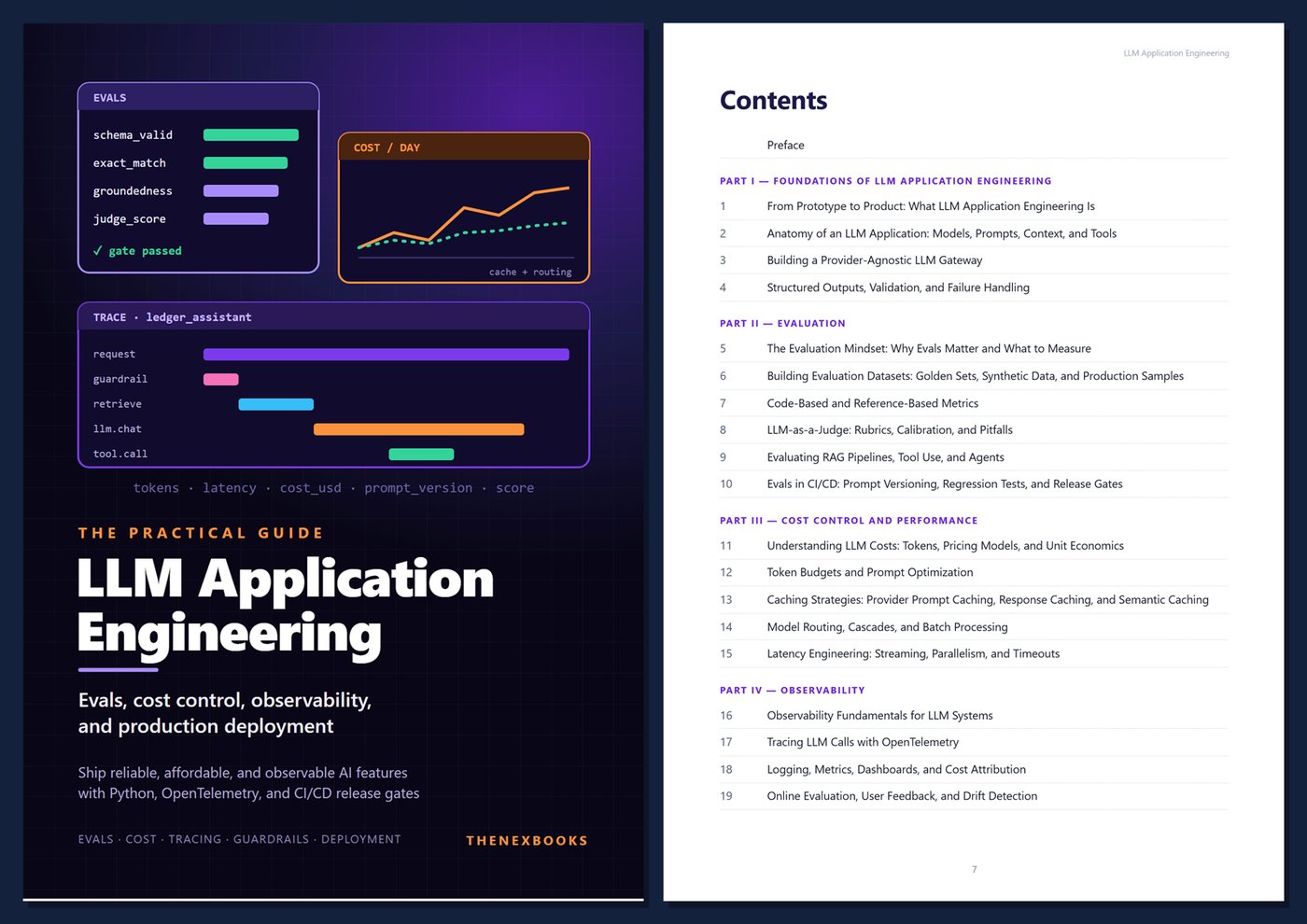
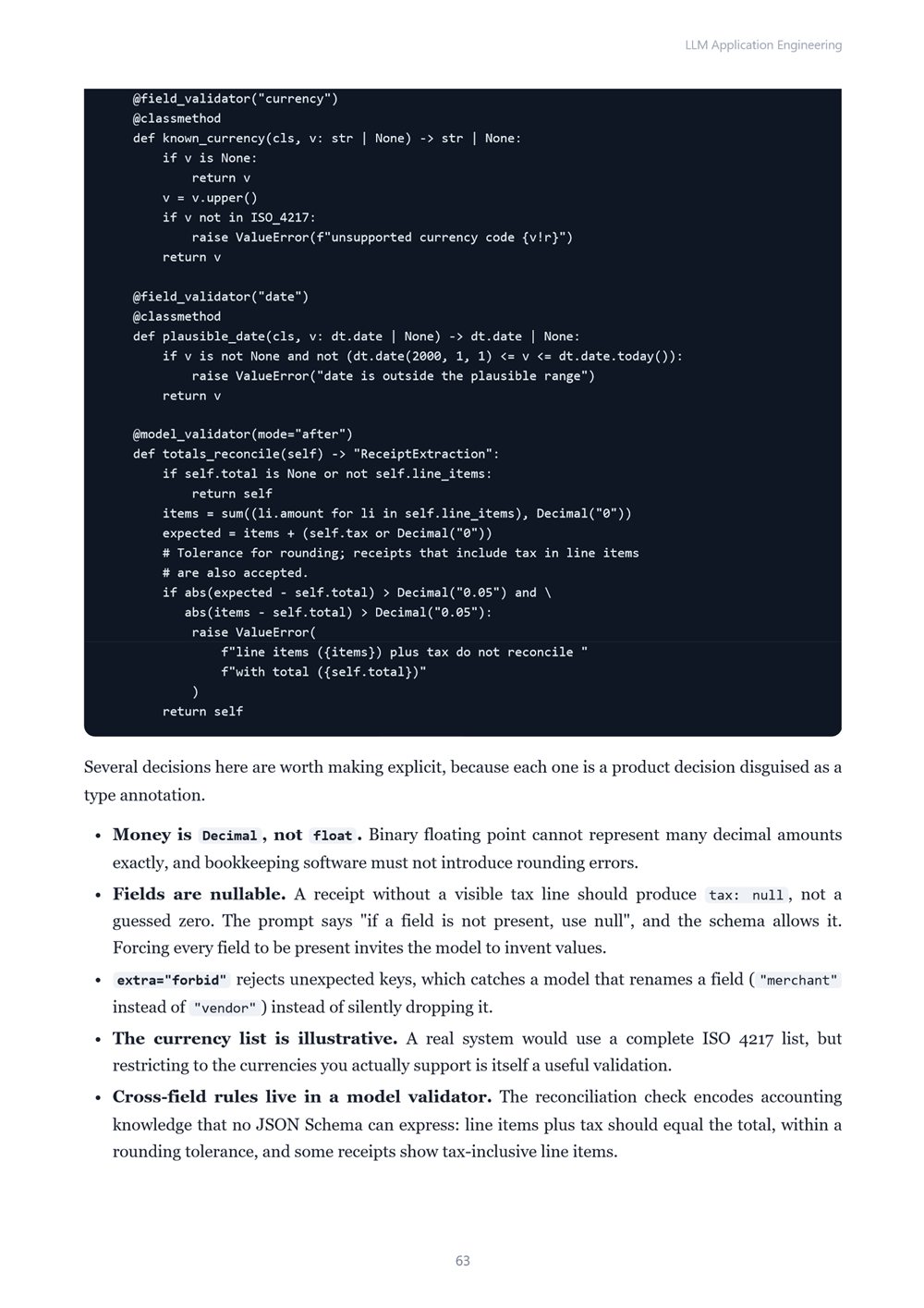
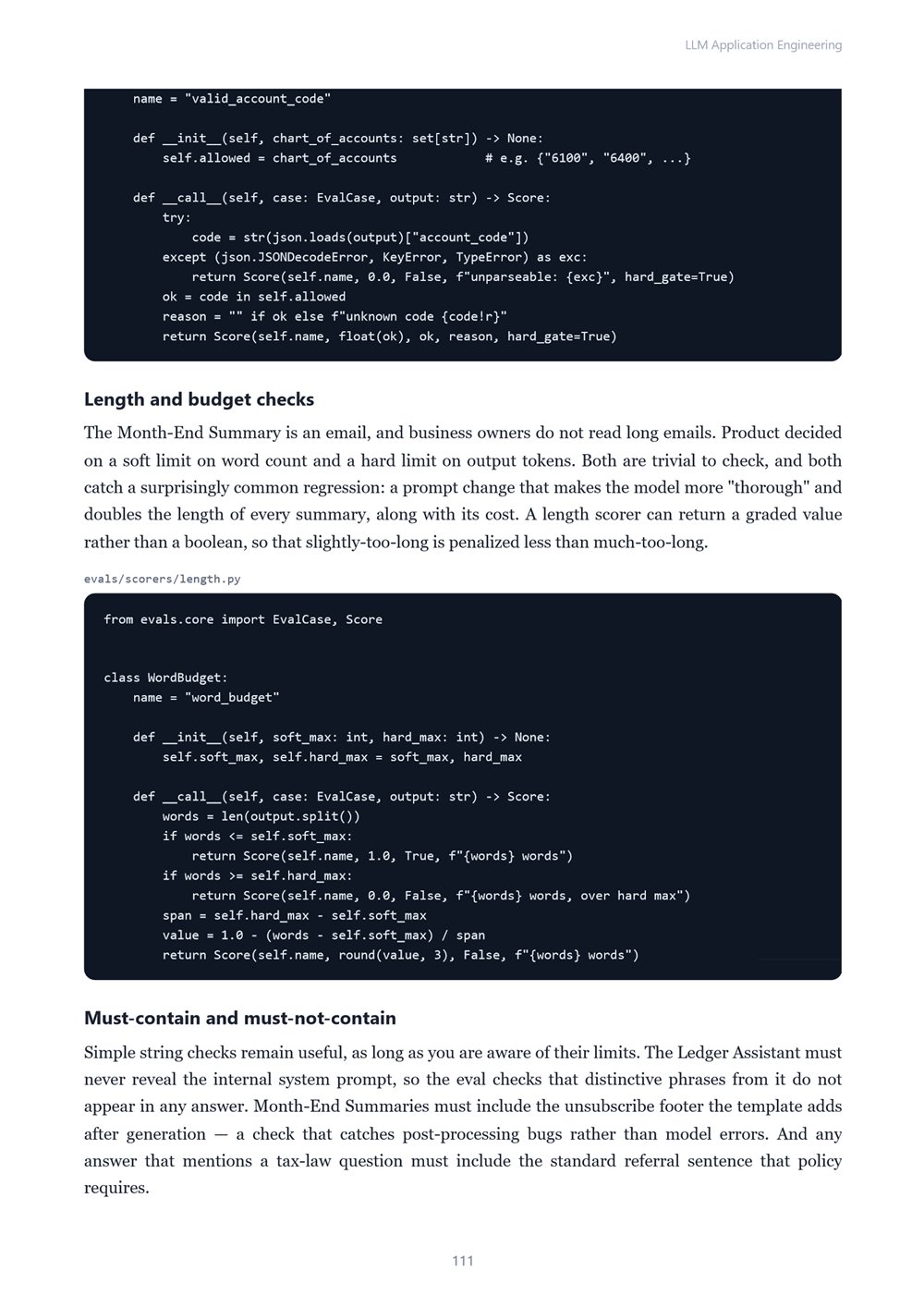
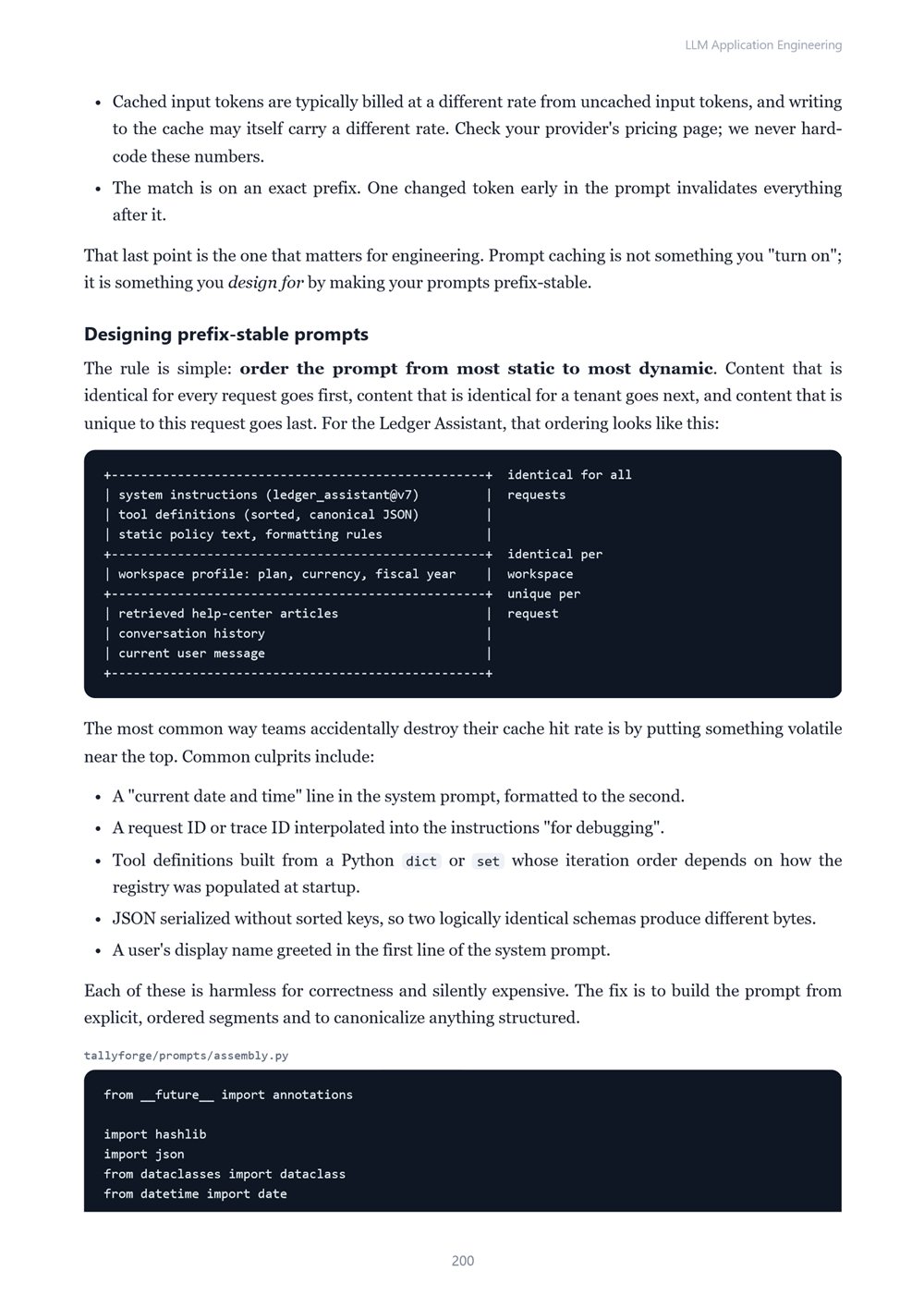
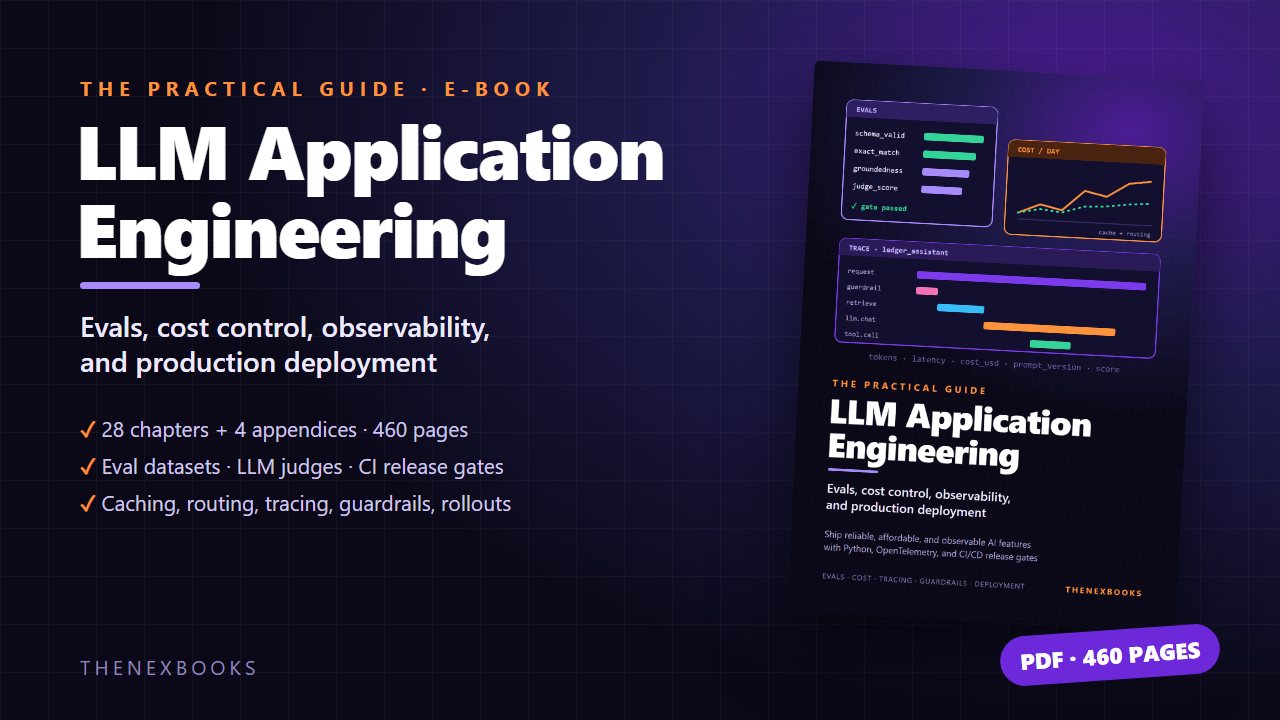
A 460-page practical guide to taking LLM features from prototype to production: evals, release gates, cost control, caching and routing, OpenTelemetry tracing, guardrails, and safe deployment.
Evals, Cost Control, Observability, and Production Deployment
Read before you buy: the PDF here is a free sample — the first 20 pages of the 460-page book (payments, sales and reviews on this demo site are sample data). Get the full e-book at thenexbooks on Gumroad.
Your LLM demo took an afternoon. Your LLM product will take engineering.
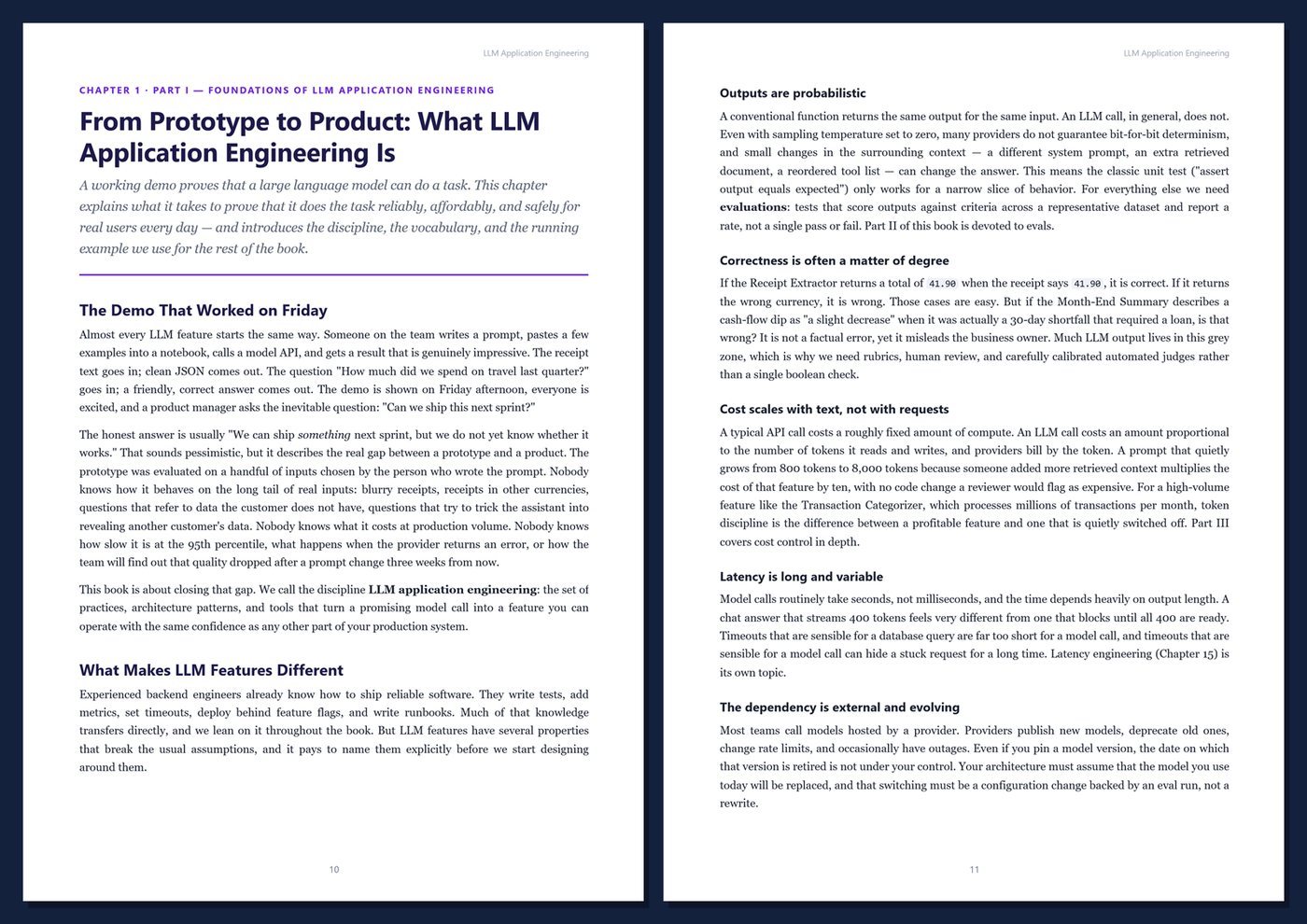
Calling a model API is easy. The hard questions come next: Is the output actually right, and how would you know? What happens to the bill when thousands of customers use it every day? Why did it give that strange answer last Tuesday? What happens when the provider slows down, rate-limits you, or changes a model? How do you ship a new prompt without breaking what already works?
This book is a practical guide to the engineering around the model — evaluation, cost, observability, reliability, security, and deployment — built step by step on one realistic running example: Tallyforge, a bookkeeping SaaS with a tool-using chat assistant, a receipt extractor, a high-volume transaction categorizer, and generated month-end summaries.
- 460 pages · 28 chapters + 4 appendices
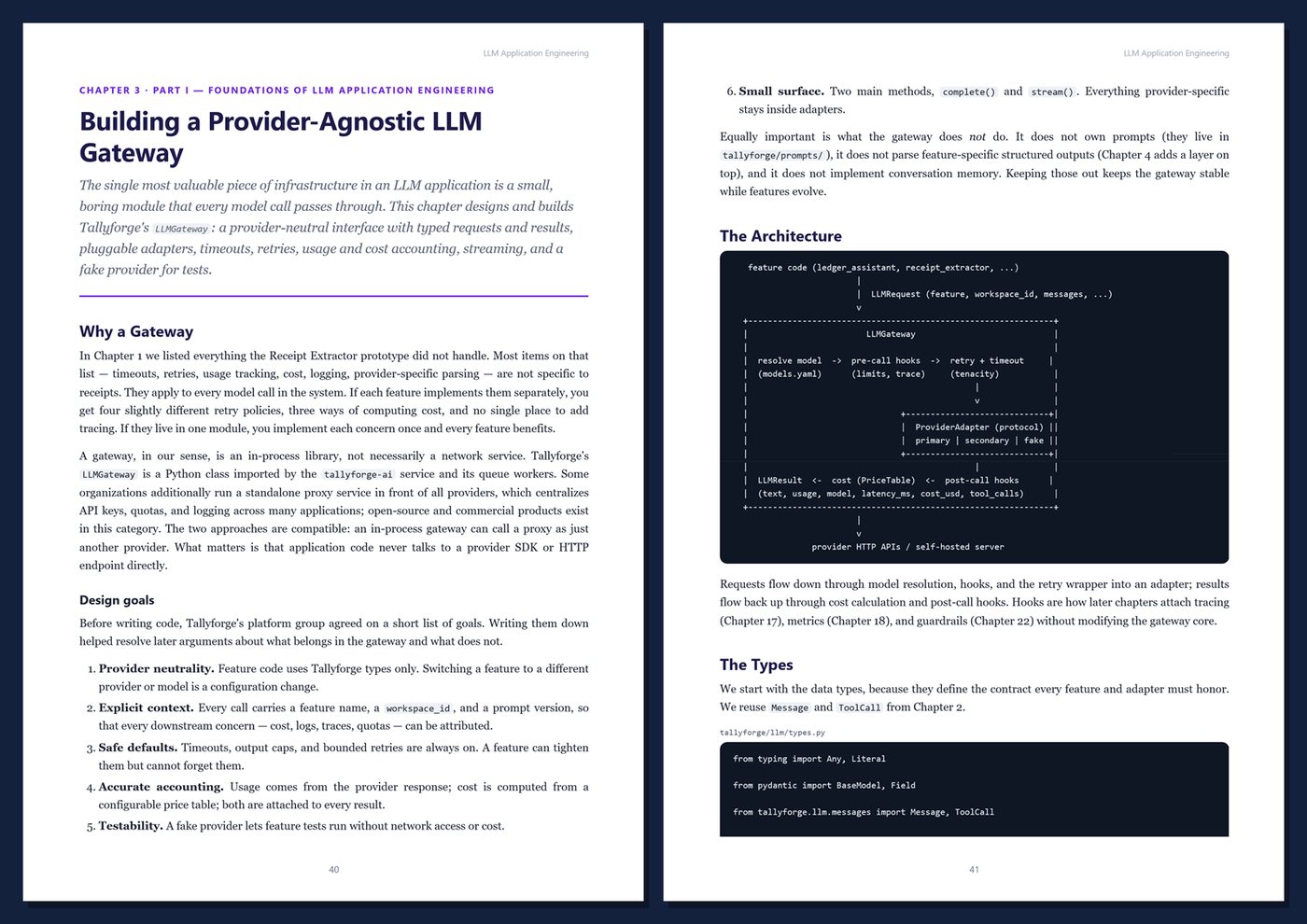
- A provider-agnostic LLM gateway, structured outputs, and validation with Pydantic
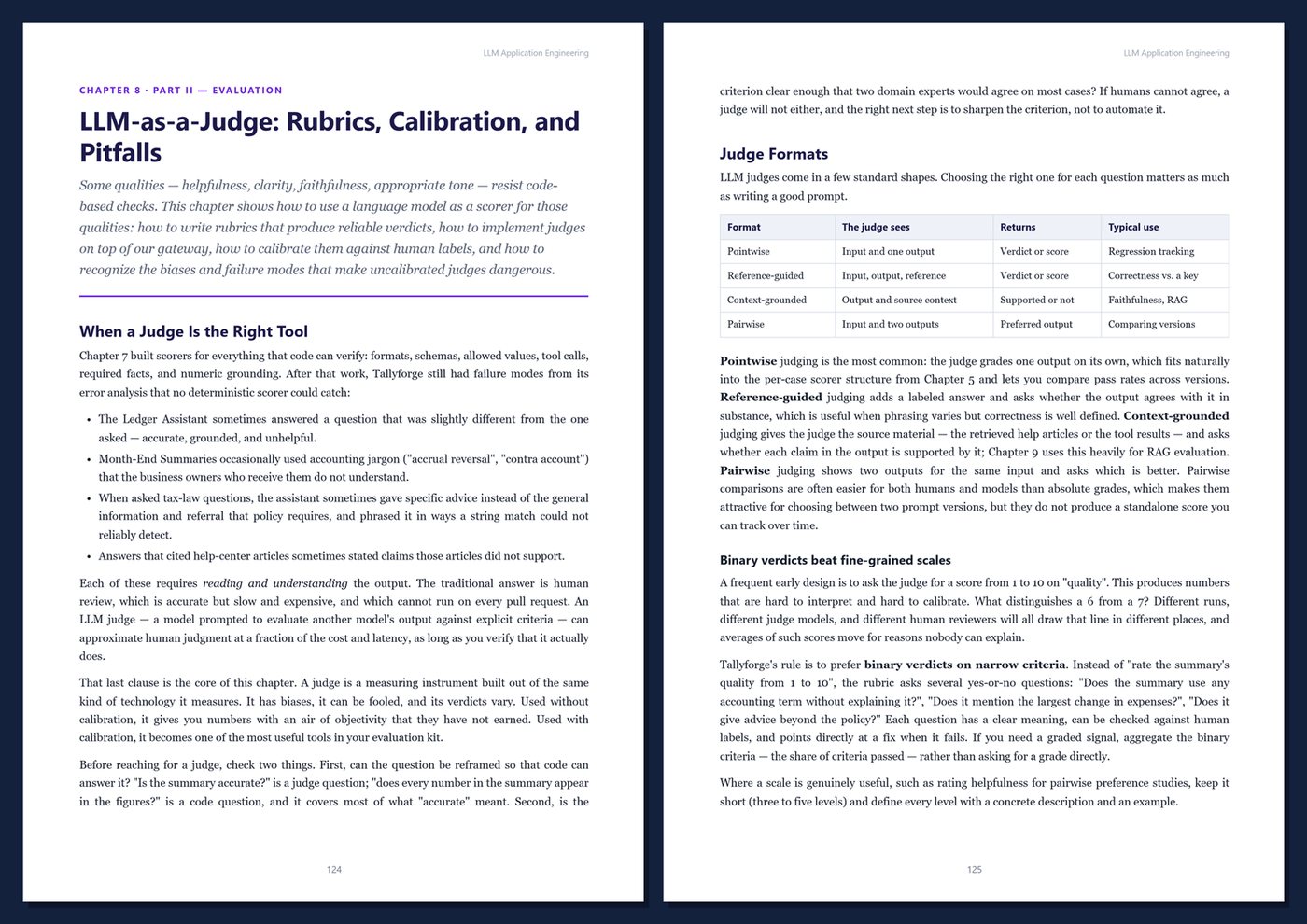
- Eval datasets, code-based metrics, and LLM-as-a-judge with calibrated rubrics
- Evaluating RAG pipelines, tool use, and agents
- Evals in CI/CD: prompt versioning, regression tests, and release gates
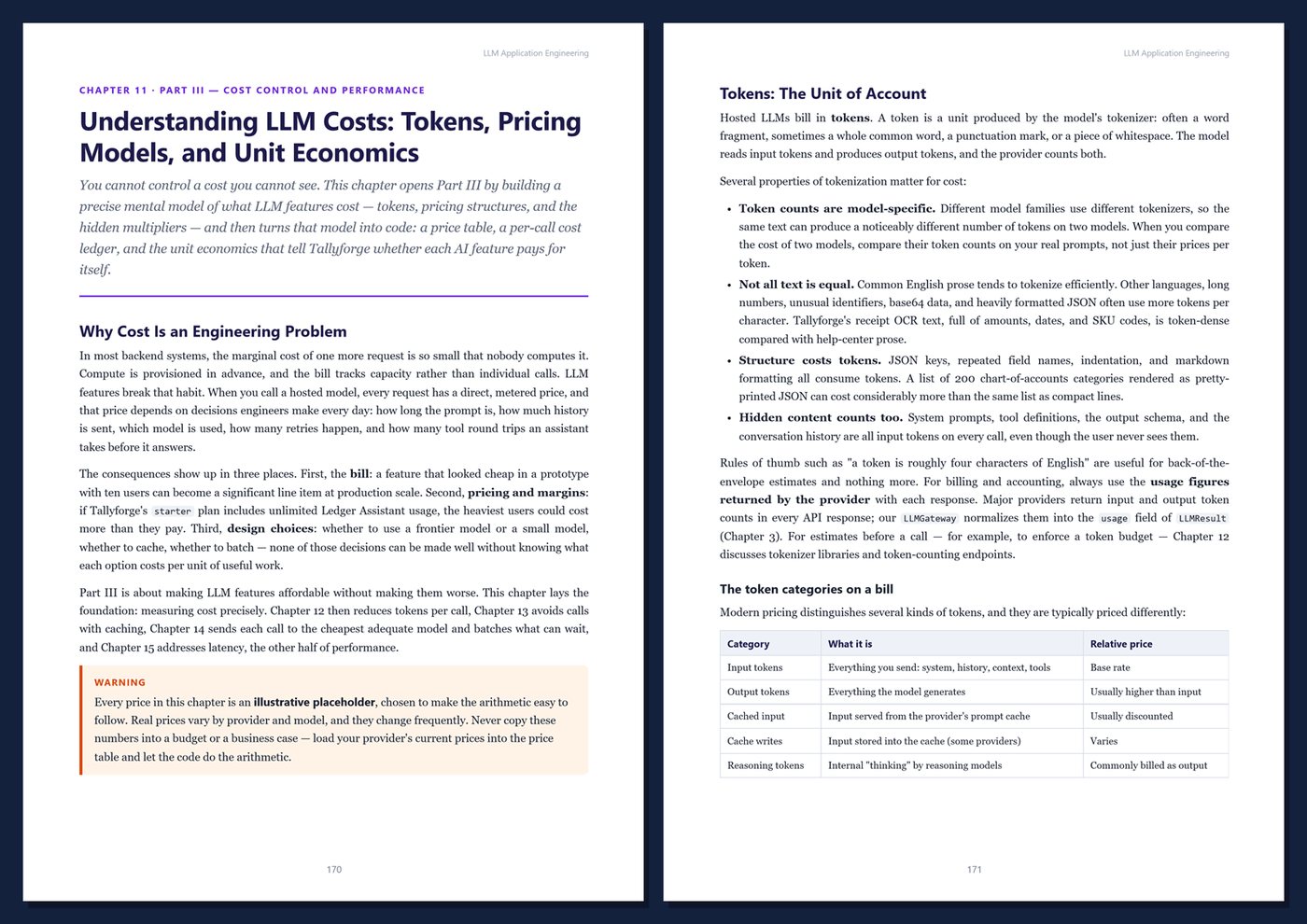
- Token costs and unit economics, budgets, prompt optimization, caching, model routing, cascades, and batching
- Latency engineering: streaming, parallelism, and timeouts
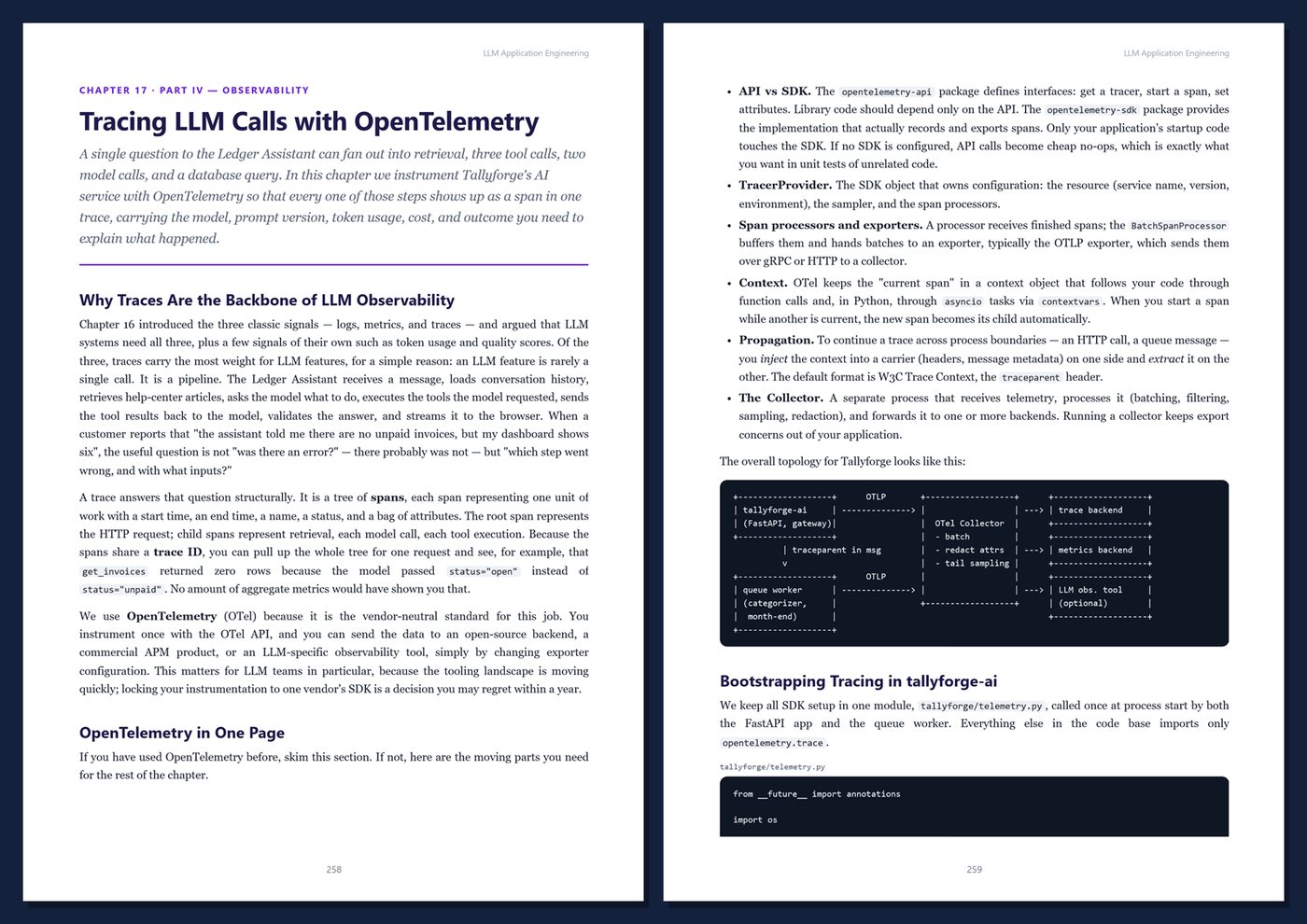
- Tracing with OpenTelemetry, metrics, dashboards, and cost attribution per feature and tenant
- Online evaluation, user feedback, drift detection, and debugging production failures
- Resilience, guardrails, prompt-injection defense, tool permissions, privacy, and data governance
- Deployment architectures, feature flags, shadow traffic, canaries, SLOs, runbooks, and a full case study
- Model- and vendor-neutral: placeholders instead of model names, illustrative prices instead of stale ones
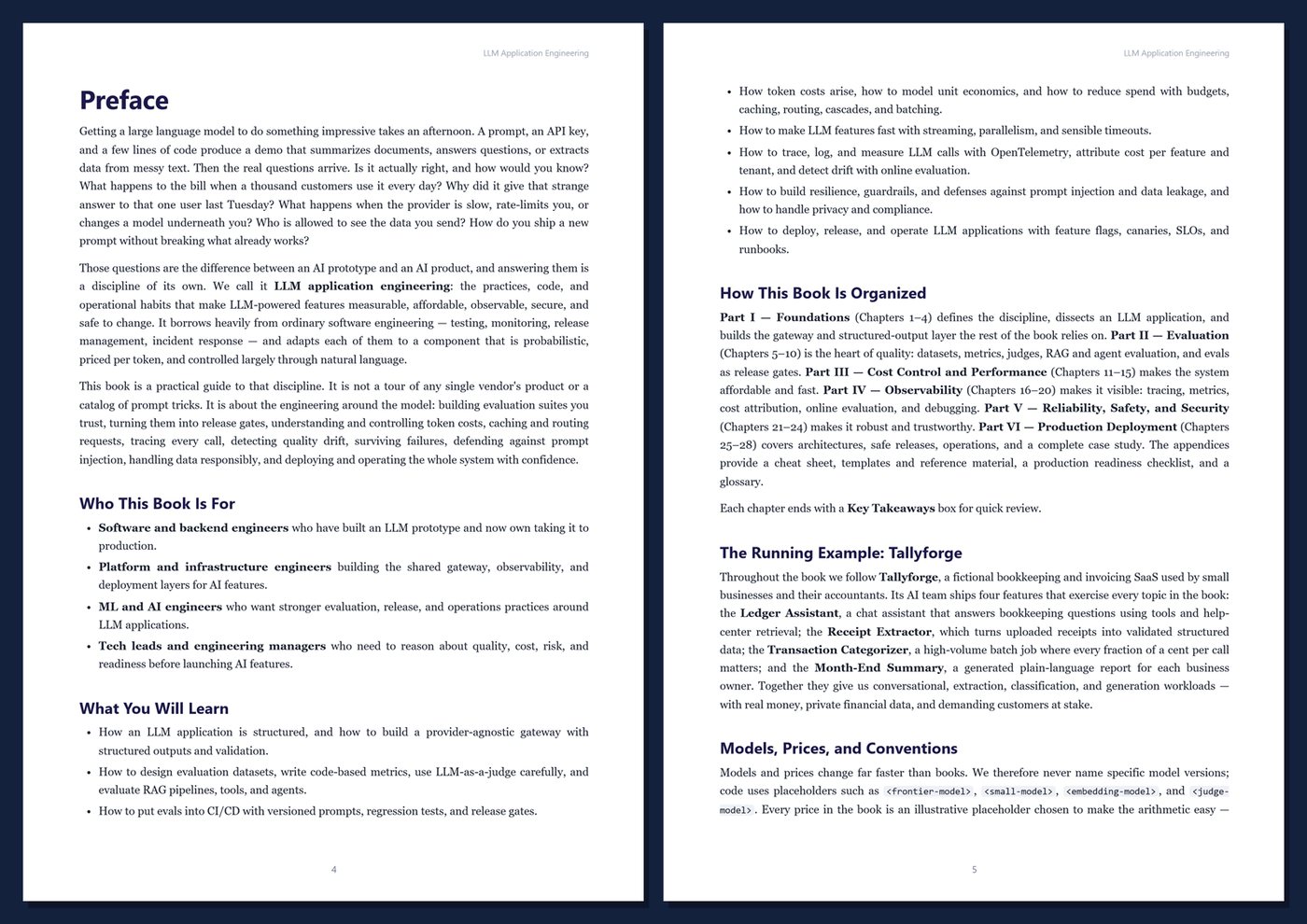
Table Of Contents
Part I — Foundations of LLM Application Engineering
- Ch 1 · From Prototype to Product: What LLM Application Engineering Is
- Ch 2 · Anatomy of an LLM Application: Models, Prompts, Context, and Tools
- Ch 3 · Building a Provider-Agnostic LLM Gateway
- Ch 4 · Structured Outputs, Validation, and Failure Handling
Part II — Evaluation
- Ch 5 · The Evaluation Mindset: Why Evals Matter and What to Measure
- Ch 6 · Building Evaluation Datasets: Golden Sets, Synthetic Data, and Production Samples
- Ch 7 · Code-Based and Reference-Based Metrics
- Ch 8 · LLM-as-a-Judge: Rubrics, Calibration, and Pitfalls
- Ch 9 · Evaluating RAG Pipelines, Tool Use, and Agents
- Ch 10 · Evals in CI/CD: Prompt Versioning, Regression Tests, and Release Gates
Part III — Cost Control and Performance
- Ch 11 · Understanding LLM Costs: Tokens, Pricing Models, and Unit Economics
- Ch 12 · Token Budgets and Prompt Optimization
- Ch 13 · Caching Strategies: Provider Prompt Caching, Response Caching, and Semantic Caching
- Ch 14 · Model Routing, Cascades, and Batch Processing
- Ch 15 · Latency Engineering: Streaming, Parallelism, and Timeouts
Part IV — Observability
- Ch 16 · Observability Fundamentals for LLM Systems
- Ch 17 · Tracing LLM Calls with OpenTelemetry
- Ch 18 · Logging, Metrics, Dashboards, and Cost Attribution
- Ch 19 · Online Evaluation, User Feedback, and Drift Detection
- Ch 20 · Debugging Production LLM Failures
Part V — Reliability, Safety, and Security
- Ch 21 · Resilience: Rate Limits, Retries, Fallbacks, and Circuit Breakers
- Ch 22 · Guardrails: Input and Output Validation, Moderation, and Policy Enforcement
- Ch 23 · Security: Prompt Injection, Data Leakage, and Tool Permissions
- Ch 24 · Privacy, Compliance, and Data Governance
Part VI — Production Deployment
- Ch 25 · Deployment Architectures: APIs, Workers, Queues, and Self-Hosted Models
- Ch 26 · Releasing Safely: Feature Flags, Shadow Traffic, Canaries, and A/B Tests
- Ch 27 · Operating LLM Applications: SLOs, On-Call, Incident Response, and Runbooks
- Ch 28 · Case Study: Taking Tallyforge's AI Features to Production
Appendices
- App A · LLM Application Engineering Cheat Sheet
- App B · Templates and Reference
- App C · Production Readiness Checklist
- App D · Glossary
WHO IT IS FOR
Software and backend engineers who have built an LLM prototype and now own taking it to production, platform engineers building shared AI infrastructure, ML and AI engineers who want stronger evaluation and operations practices, and tech leads who must reason about quality, cost, and risk before launch. Examples use Python, FastAPI, Pydantic, pytest, and OpenTelemetry.
FORMAT
PDF (A4), 460 pages, English, clickable table of contents and PDF bookmarks. 1st Edition, 2026. Published by thenexbooks.
This book is independent and is not affiliated with or endorsed by any AI model provider or by the OpenTelemetry project. All product names are trademarks of their respective owners. Prices in the book are illustrative placeholders; always check your provider's current pricing.
Book details
| Detail | |
|---|---|
| Pages | 460 |
| Format | PDF (A4) |
| Language | English |
| Level | Intermediate to Advanced |
| Edition | 1st Edition, 2026 |
| Download on this site | Free sample, first 20 pages (PDF) |
| Publisher | thenexbooks |
Files you get
No reviews yet. Only buyers can review.
More from thenexbooks