 1 / 11
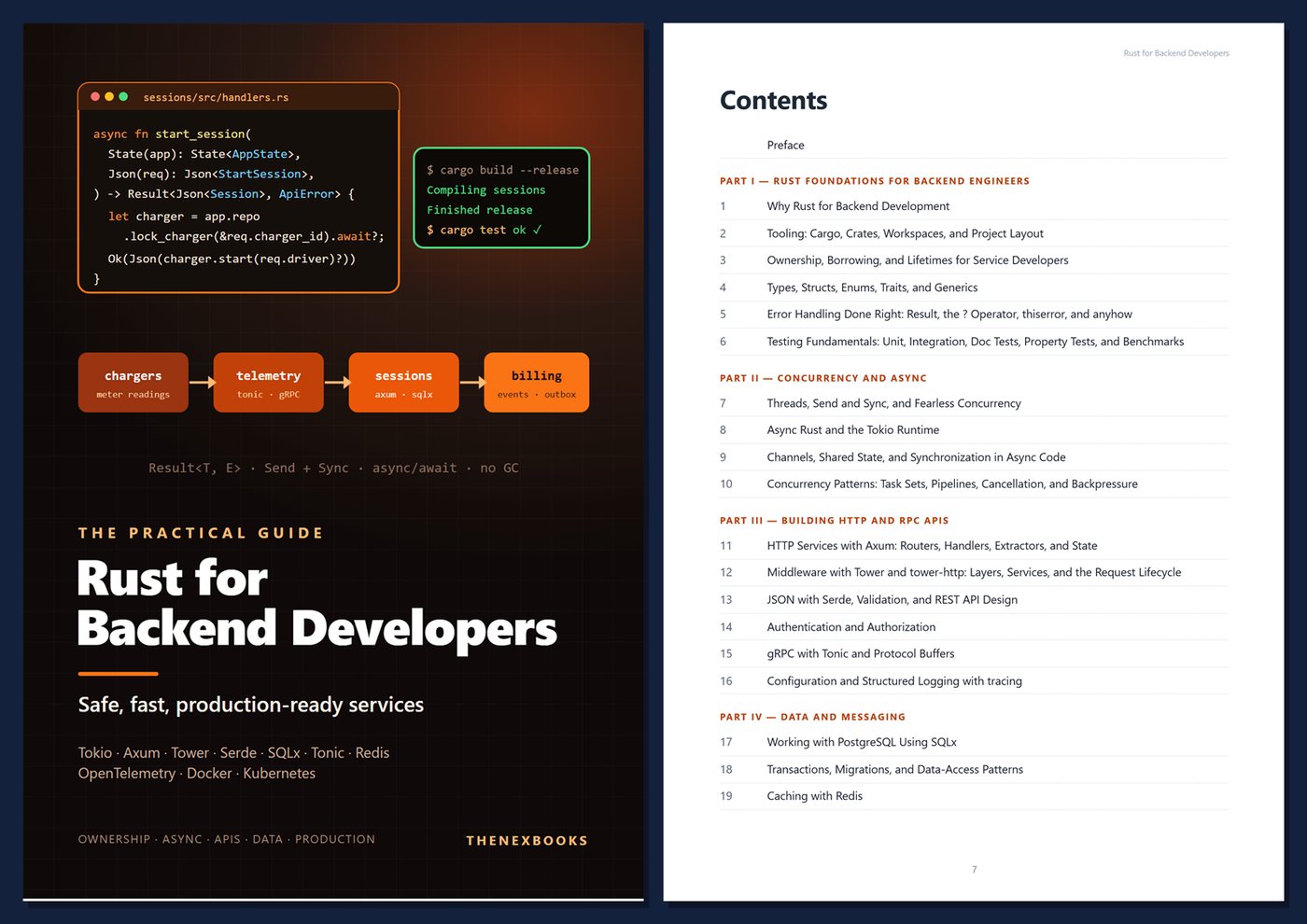
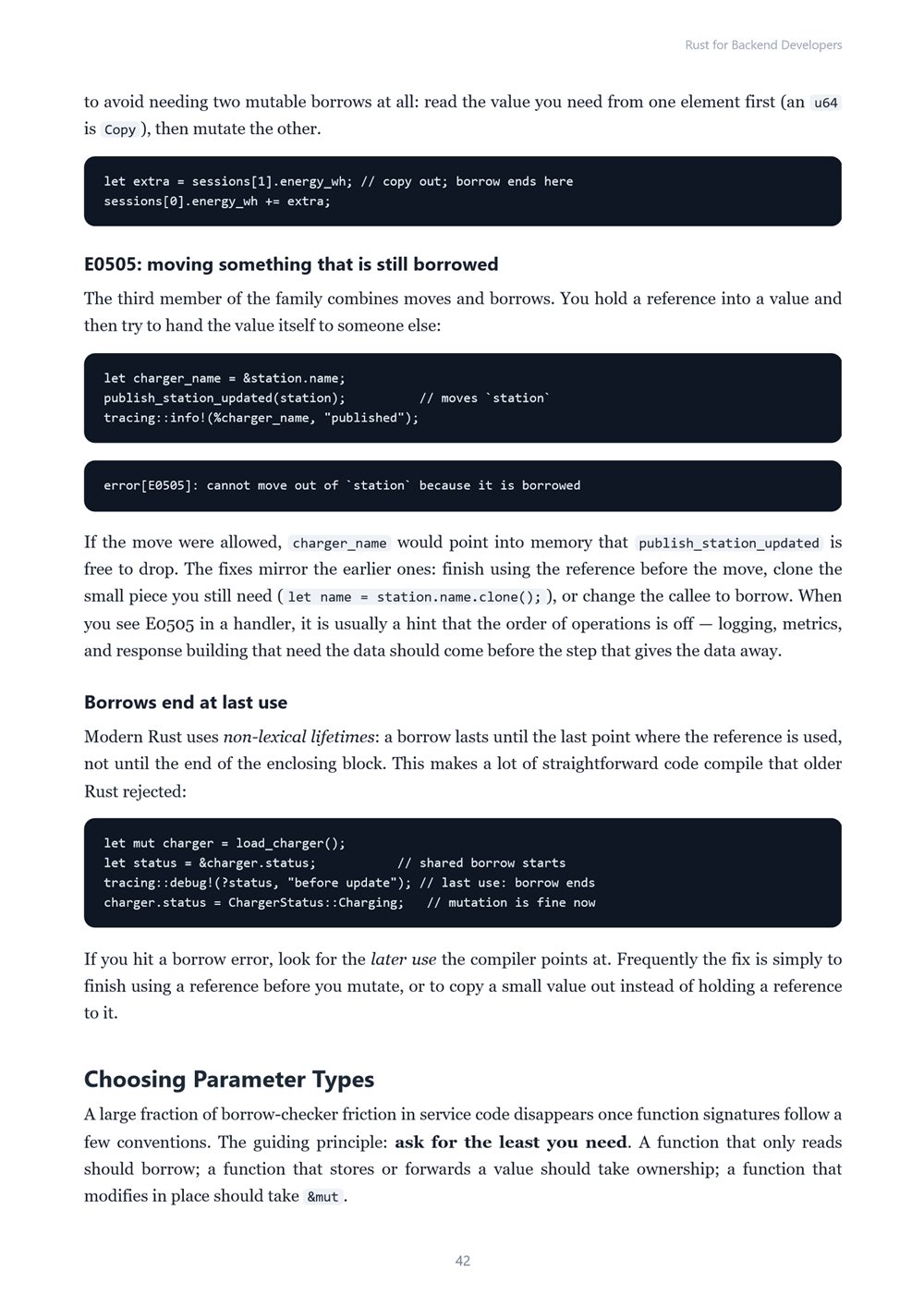
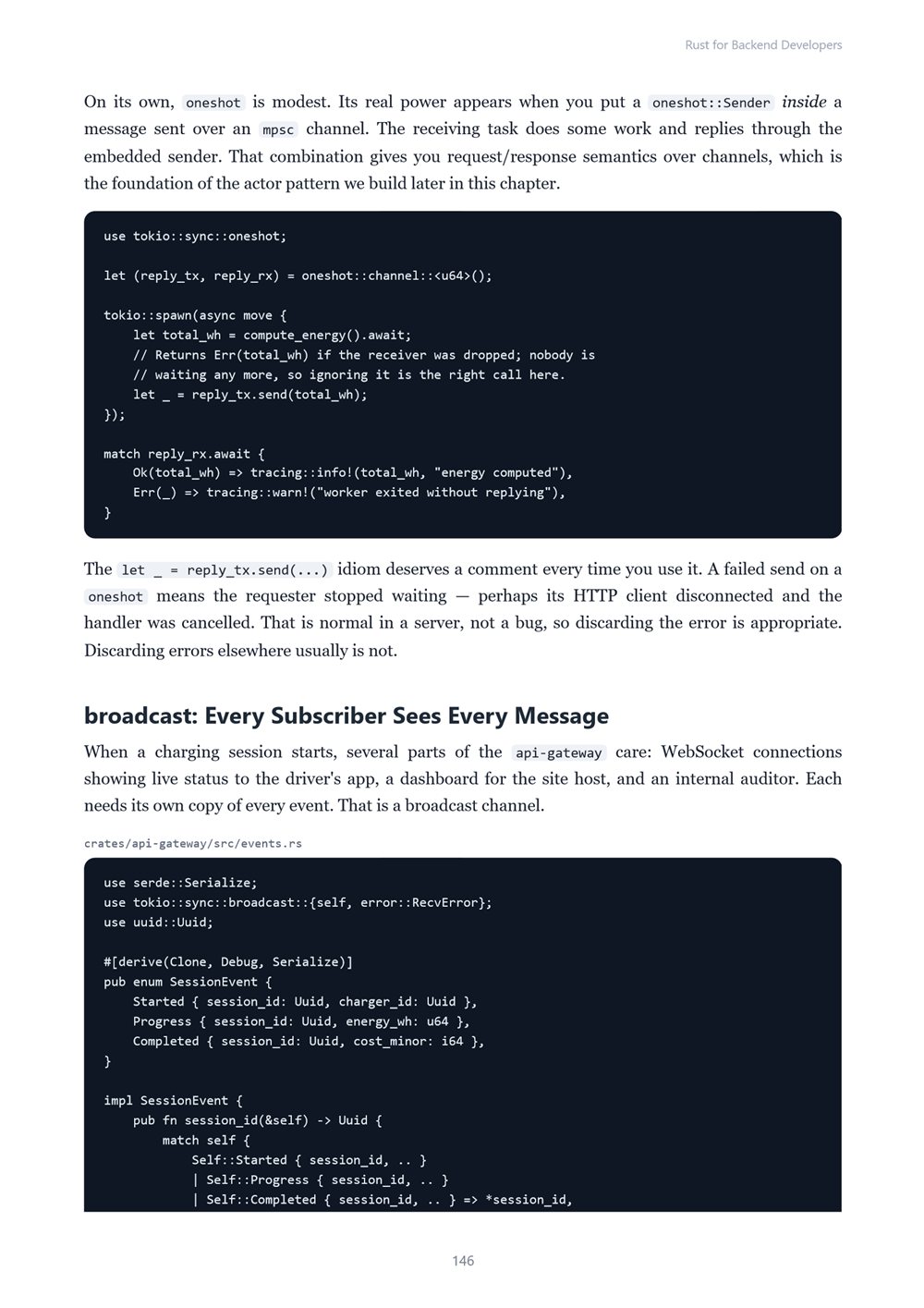
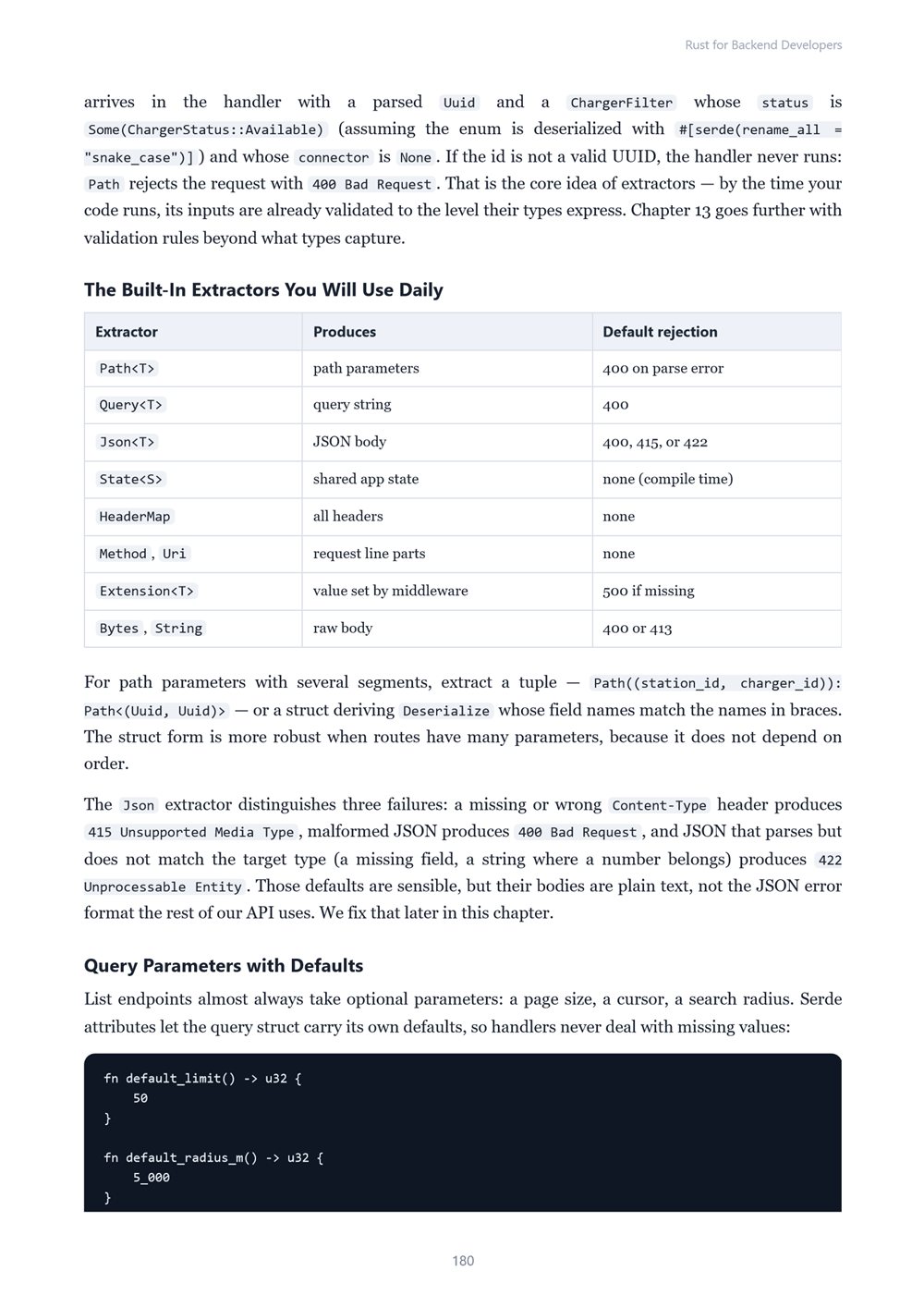
A 504-page practical guide to building safe, fast, production-ready backend services in Rust with Tokio, Axum, SQLx, Tonic, Redis, and OpenTelemetry. The companion to Go for Backend Developers.
Safe, Fast, Production-Ready Services
Read before you buy: the PDF here is a free sample — the first 20 pages of the 504-page book (payments, sales and reviews on this demo site are sample data). Get the full e-book at thenexbooks on Gumroad.
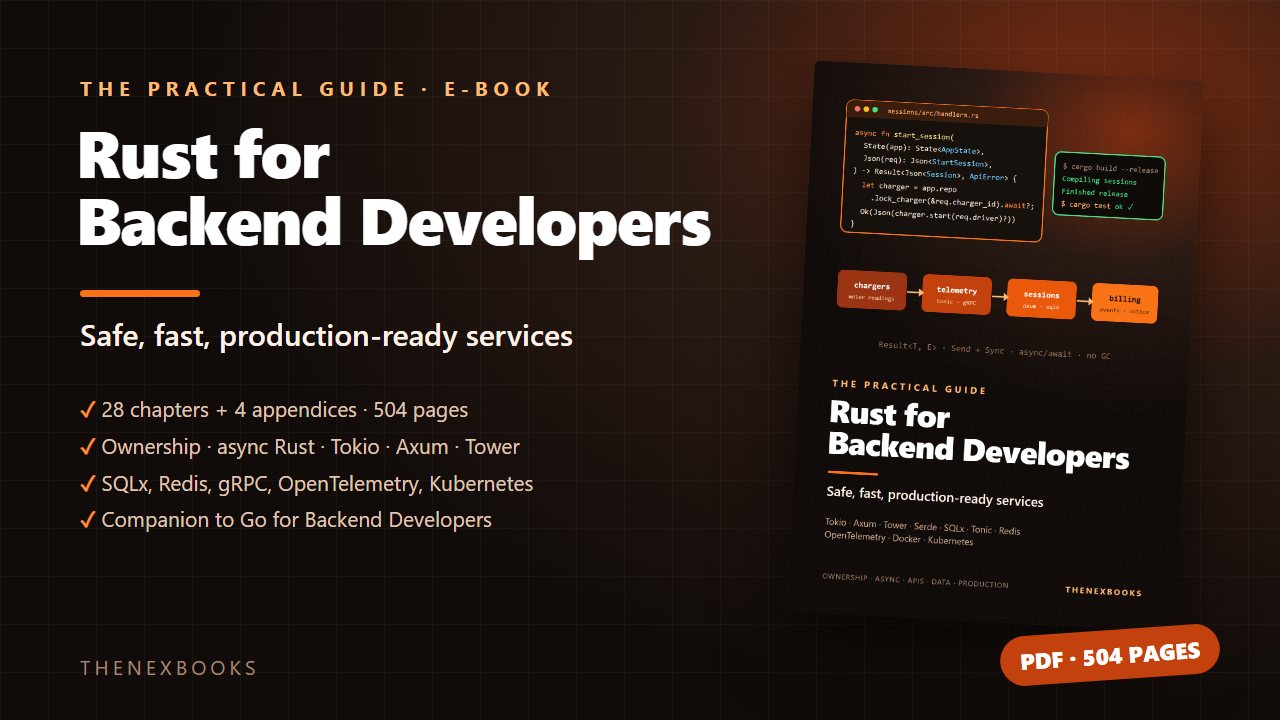
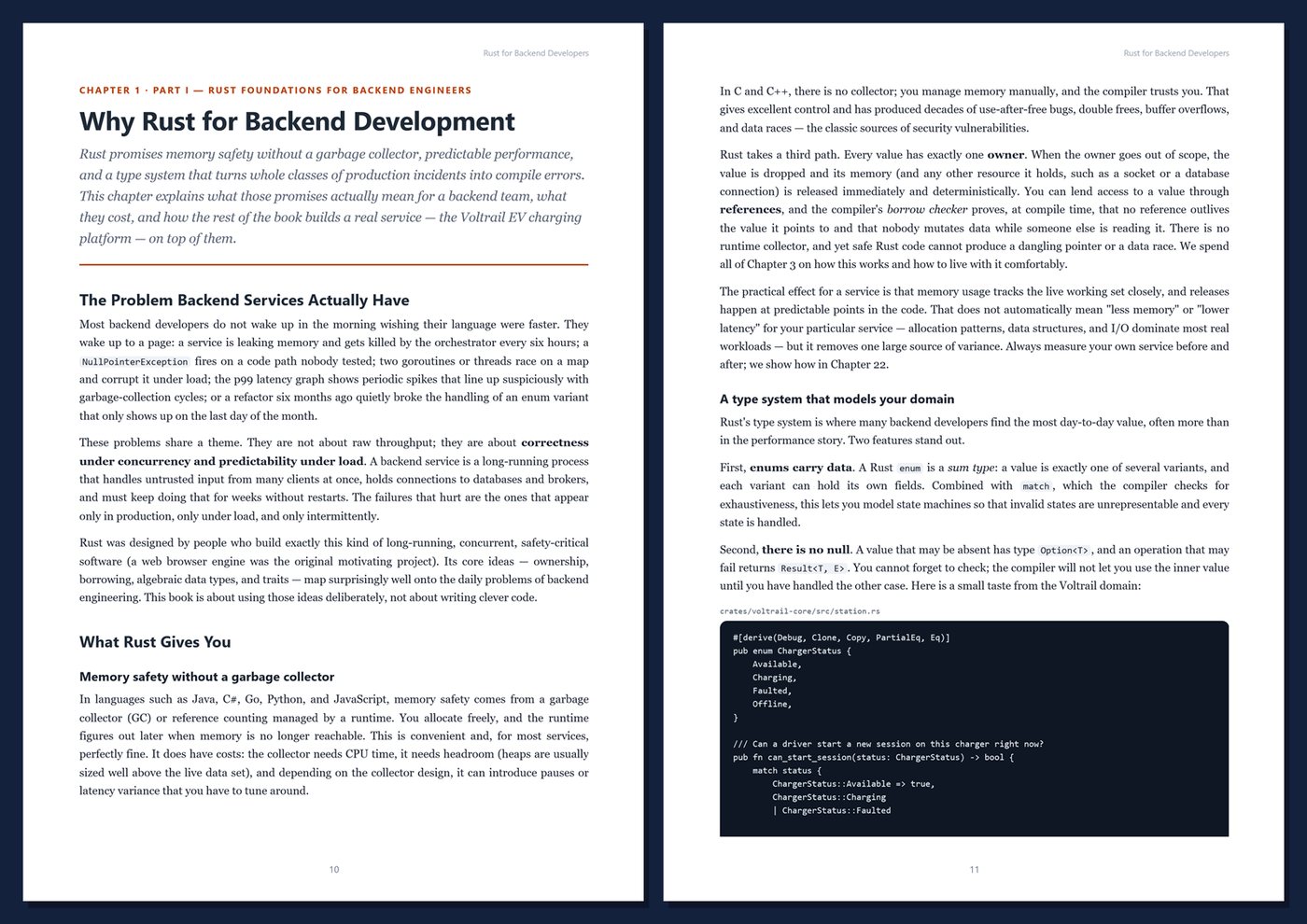
Rust's promise for backend services: whole classes of bugs gone before the code ever runs.
Data races, null dereferences, use-after-free, forgotten errors, leaked connections — the bugs that turn into 3 a.m. incidents. Rust rules out many of them at compile time, and it does so without a garbage collector, so your services get predictable latency and a small, steady memory footprint. The price is a steeper learning curve. This book helps you pay it once, with a clear focus on what backend services actually need.
It is not a language reference. It is a practical guide to building production services in Rust: HTTP and gRPC APIs, databases, caching, messaging, observability, resilience, security, deployment, and architecture. We follow one realistic running example all the way: Voltrail, an EV charging network with a public API, a session state machine with money attached, high-volume charger telemetry, payments, events, and background jobs.
- 504 pages · 28 chapters + 4 appendices
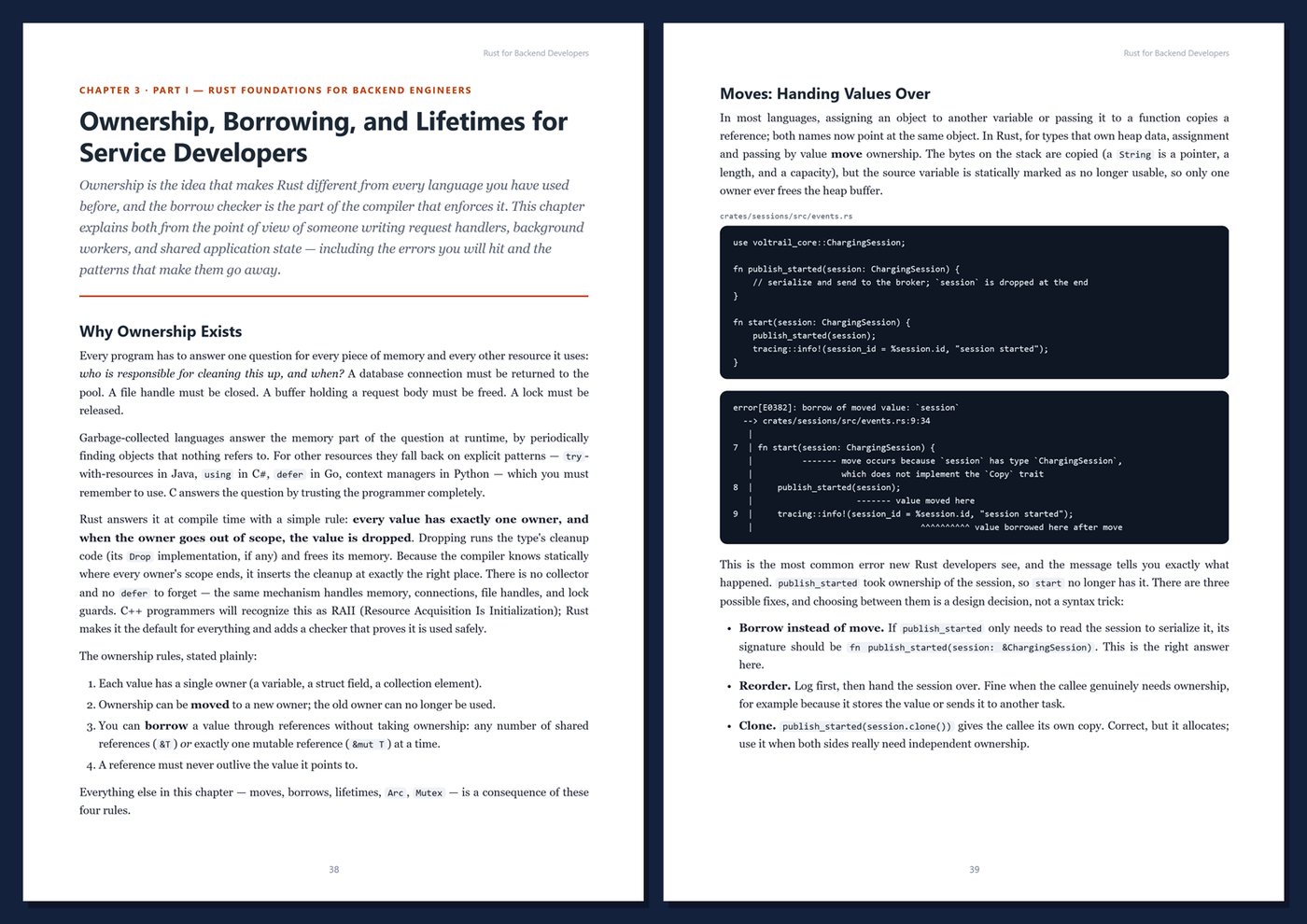
- Cargo, workspaces, ownership, borrowing, and lifetimes explained for service developers
- Traits, generics, and idiomatic error handling with Result, thiserror, and anyhow
- Testing: unit, integration, doc tests, property tests, and benchmarks
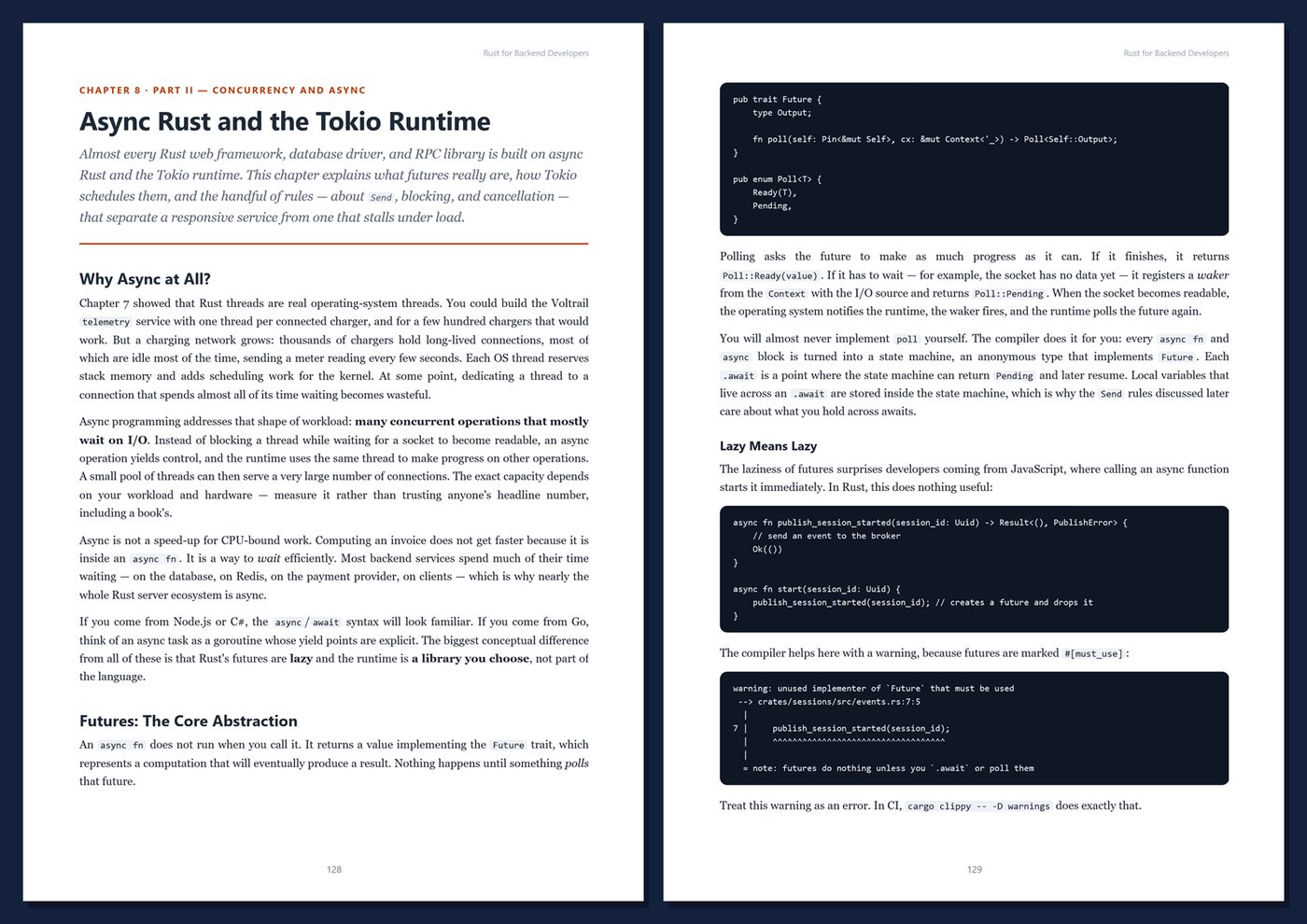
- Threads, Send and Sync, async Rust, Tokio, channels, cancellation, and backpressure
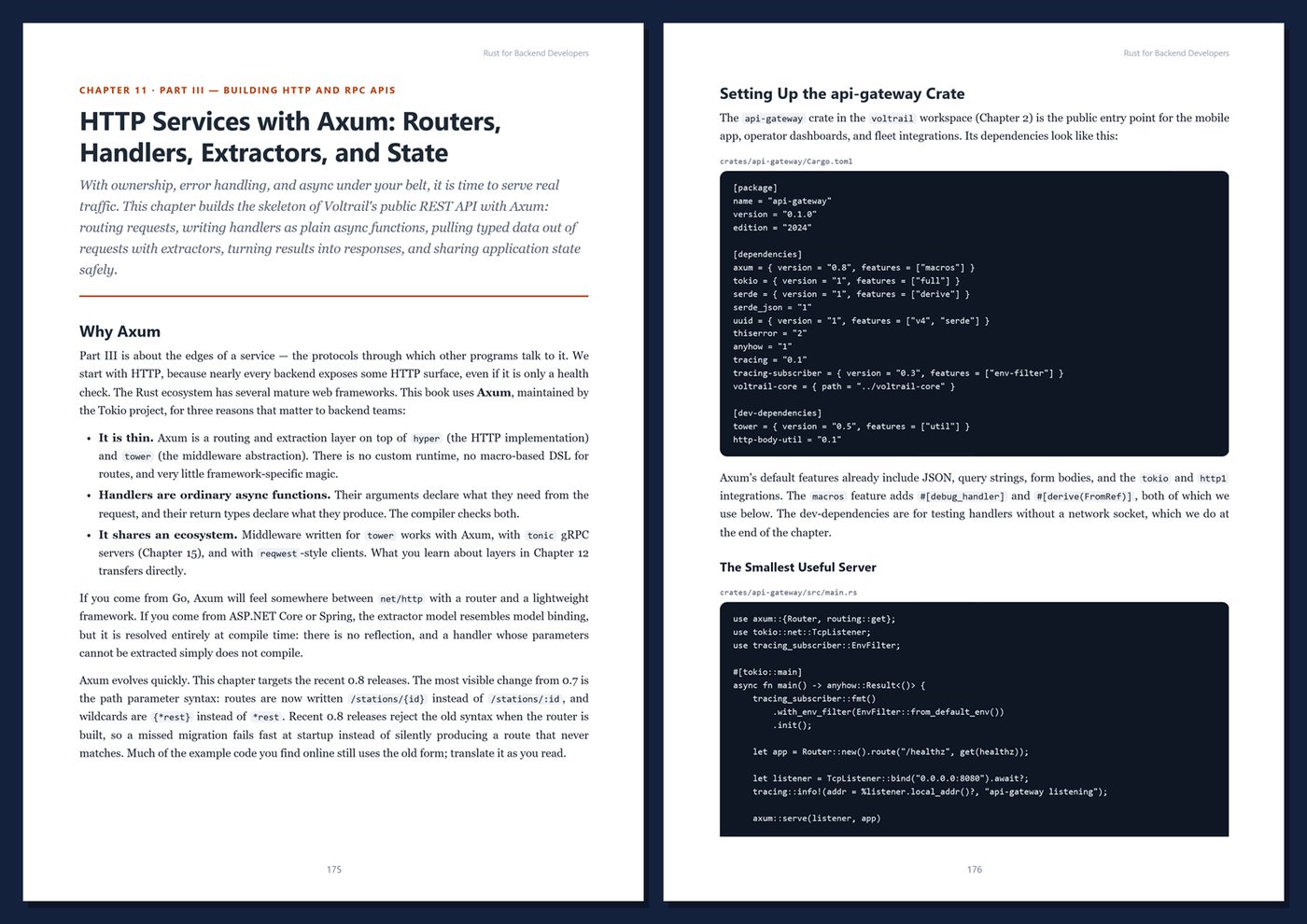
- REST APIs with Axum and Tower middleware, JSON with Serde, validation, authentication, and authorization
- gRPC with Tonic, configuration, and structured logging with tracing
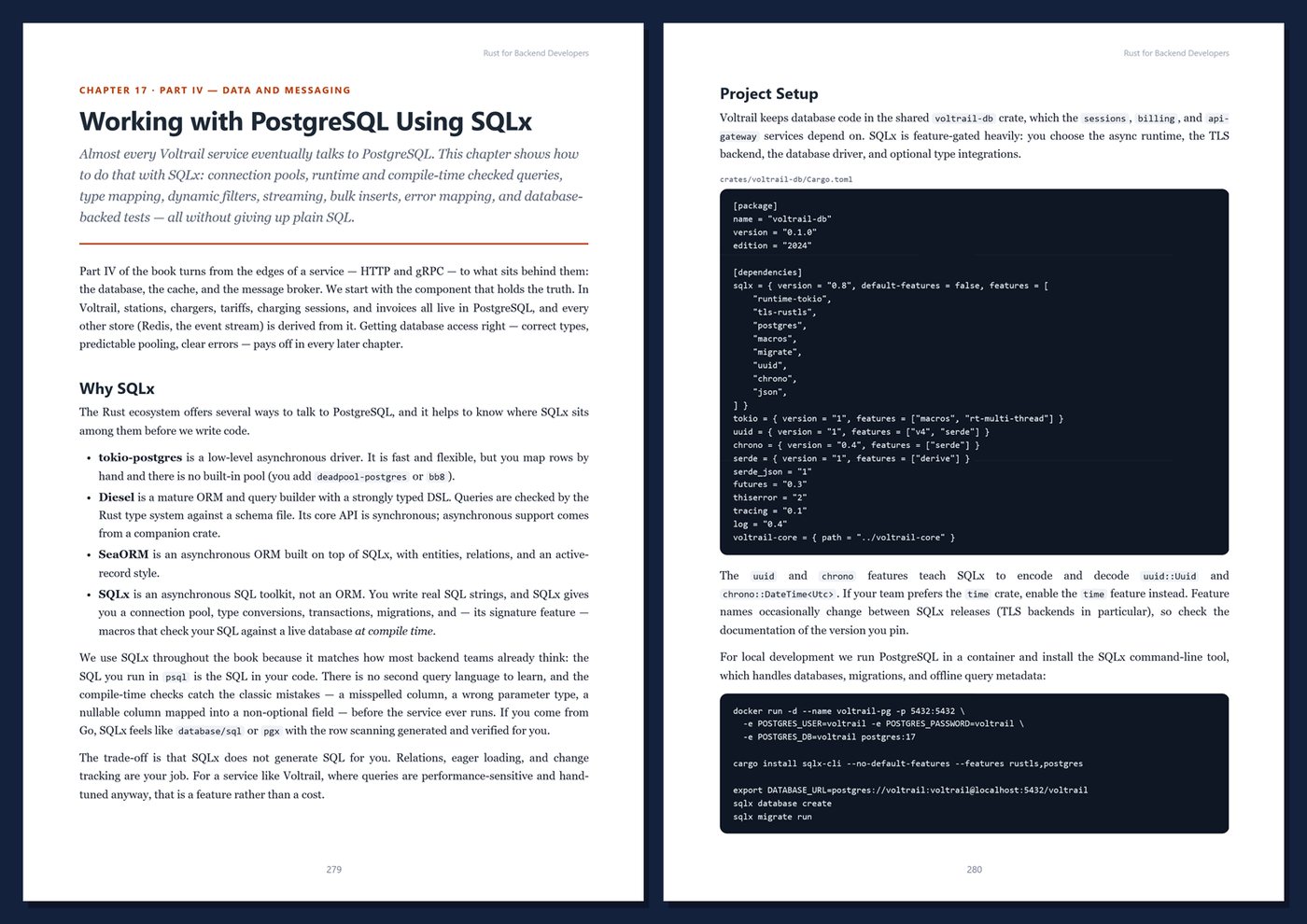
- PostgreSQL with SQLx, transactions, migrations, Redis caching, events, and the outbox pattern
- OpenTelemetry, profiling, resilience, graceful shutdown, and supply-chain security
- Docker, Kubernetes, CI/CD, hexagonal architecture, and two end-to-end case studies
- The companion to Go (Golang) for Backend Developers — same six-part structure, so you can compare the two languages chapter by chapter
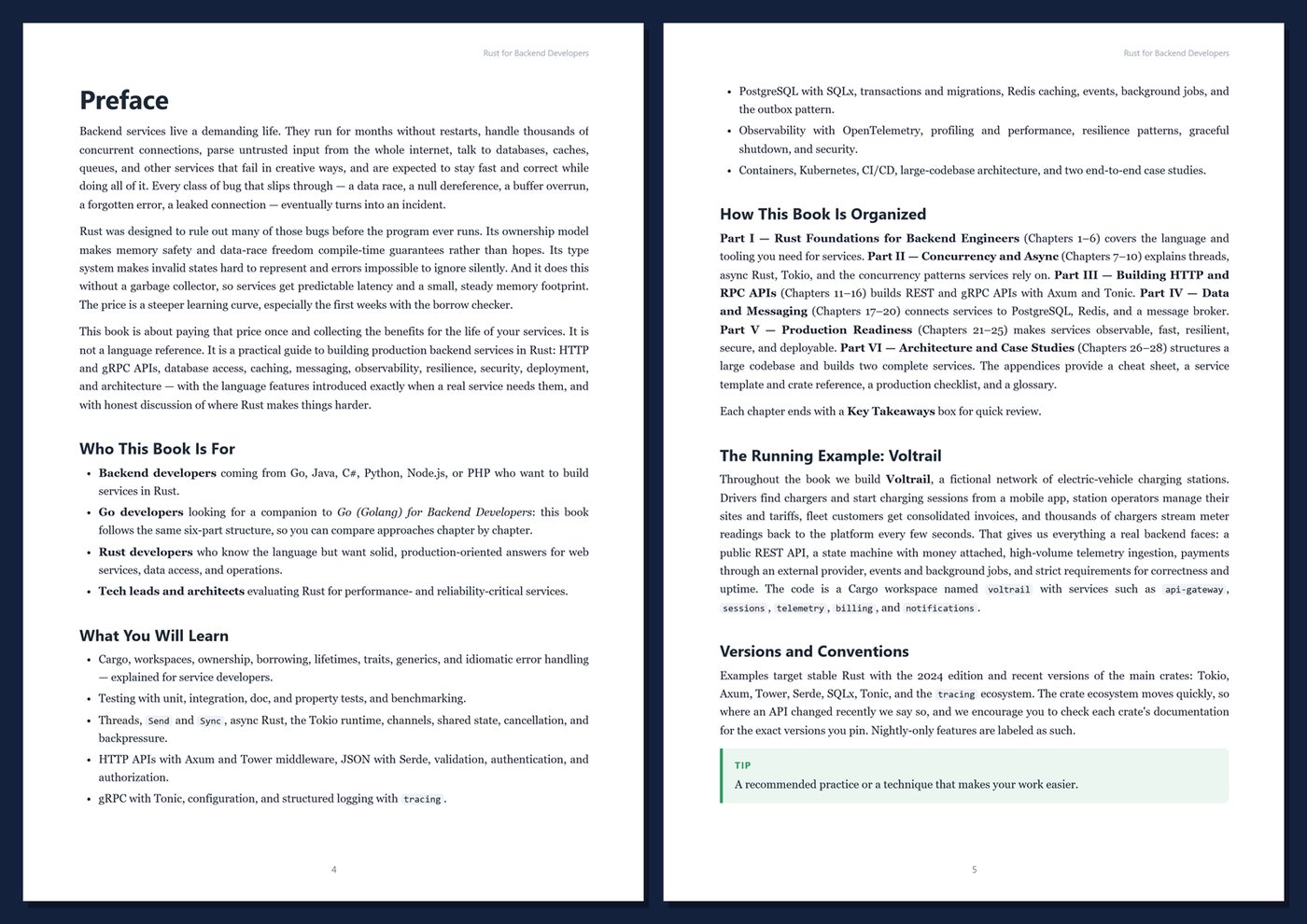
Table Of Contents
Part I — Rust Foundations for Backend Engineers
- Ch 1 · Why Rust for Backend Development
- Ch 2 · Tooling: Cargo, Crates, Workspaces, and Project Layout
- Ch 3 · Ownership, Borrowing, and Lifetimes for Service Developers
- Ch 4 · Types, Structs, Enums, Traits, and Generics
- Ch 5 · Error Handling Done Right: Result, the ? Operator, thiserror, and anyhow
- Ch 6 · Testing Fundamentals: Unit, Integration, Doc Tests, Property Tests, and Benchmarks
Part II — Concurrency and Async
- Ch 7 · Threads, Send and Sync, and Fearless Concurrency
- Ch 8 · Async Rust and the Tokio Runtime
- Ch 9 · Channels, Shared State, and Synchronization in Async Code
- Ch 10 · Concurrency Patterns: Task Sets, Pipelines, Cancellation, and Backpressure
Part III — Building HTTP and RPC APIs
- Ch 11 · HTTP Services with Axum: Routers, Handlers, Extractors, and State
- Ch 12 · Middleware with Tower and tower-http: Layers, Services, and the Request Lifecycle
- Ch 13 · JSON with Serde, Validation, and REST API Design
- Ch 14 · Authentication and Authorization
- Ch 15 · gRPC with Tonic and Protocol Buffers
- Ch 16 · Configuration and Structured Logging with tracing
Part IV — Data and Messaging
- Ch 17 · Working with PostgreSQL Using SQLx
- Ch 18 · Transactions, Migrations, and Data-Access Patterns
- Ch 19 · Caching with Redis
- Ch 20 · Messaging, Events, and Background Jobs
Part V — Production Readiness
- Ch 21 · Observability: Metrics, Tracing, and OpenTelemetry
- Ch 22 · Performance: Profiling, Allocations, and Zero-Cost Abstractions in Practice
- Ch 23 · Resilience: Timeouts, Retries, Rate Limiting, Load Shedding, and Graceful Shutdown
- Ch 24 · Security for Rust Services
- Ch 25 · Containers, Kubernetes, and CI/CD for Rust
Part VI — Architecture and Case Studies
- Ch 26 · Structuring Large Rust Codebases: Workspaces, Modules, and Hexagonal Design
- Ch 27 · Case Study: Building the Voltrail Charging Session Service End to End
- Ch 28 · Case Study: Adding an AI Assistant Backend in Rust
Appendices
- App A · Rust Backend Cheat Sheet
- App B · Service Template and Crate Reference
- App C · Production Checklist
- App D · Glossary
WHO IT IS FOR
Backend developers coming from Go, Java, C#, Python, Node.js, or PHP who want to build services in Rust; Go developers who want a side-by-side companion; Rust developers who want production-oriented answers for web services and operations; and tech leads evaluating Rust for performance- and reliability-critical systems.
FORMAT
PDF (A4), 504 pages, English, clickable table of contents and PDF bookmarks. 1st Edition, 2026. Published by thenexbooks.
This book is independent and is not affiliated with or endorsed by the Rust Foundation or the Rust Project. Rust and Cargo are trademarks of the Rust Foundation. All other product names are trademarks of their respective owners.
Book details
| Detail | |
|---|---|
| Pages | 504 |
| Format | PDF (A4) |
| Language | English |
| Level | Intermediate to Advanced |
| Edition | 1st Edition, 2026 |
| Download on this site | Free sample, first 20 pages (PDF) |
| Publisher | thenexbooks |
Files you get
No reviews yet. Only buyers can review.
More from thenexbooks